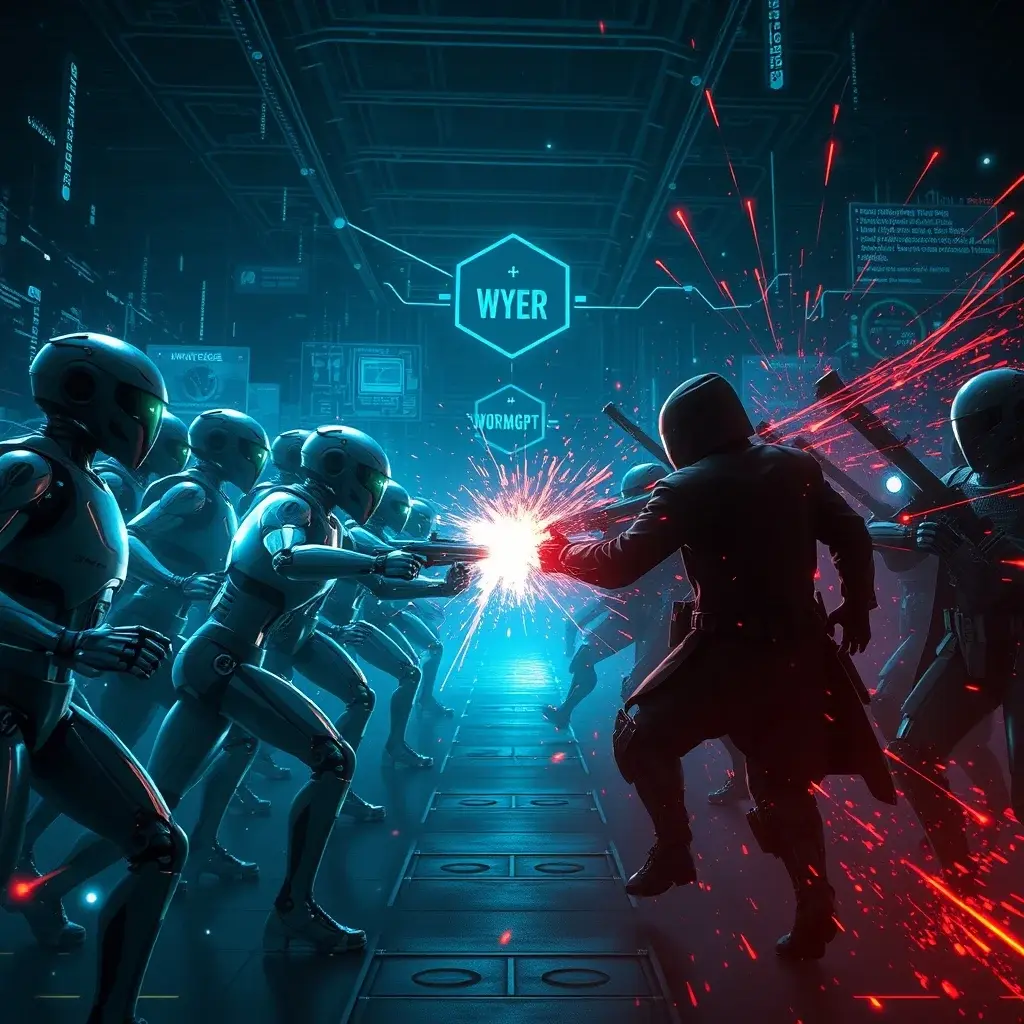

The digital battlefield is no longer fought with guns and tanks, but with lines of code and algorithms that learn, adapt, and outmaneuver adversaries in real time. Welcome to the cybersecurity arms race, where artificial intelligence (AI) is the most powerful weapon on both sides. On one hand, businesses deploy AI-driven tools like Darktrace and CrowdStrike to detect and neutralize cyber threats before they inflict damage. On the other, cybercriminals wield AI to craft smarter phishing emails, automate ransomware attacks, and exploit vulnerabilities faster than ever before.
The stakes have never been higher. In 2026, organizations worldwide are projected to spend over $230 billion on cybersecurity solutions, yet the number of reported cyber incidents continues to climb. According to IBM’s Cost of a Data Breach Report, the average cost of a single data breach in 2026 has reached $4.88 million, a figure that underscores the urgent need for advanced defenses. This is where AI enters the picture—not merely as a tool, but as a game-changer that is redefining the rules of engagement in cyber warfare.
But how exactly is AI being used to detect and prevent cyber threats? And perhaps more critically, how are hackers leveraging AI to bypass these very defenses? To answer these questions, we must first understand the dual role AI plays in this high-stakes environment. We’ll explore the most advanced AI-powered cybersecurity platforms, dissect real-world cyberattacks that have utilized AI, and reveal the strategic countermeasures organizations can deploy to stay ahead of the curve.
📰 The New Battlefield: AI in Cybersecurity
The cybersecurity landscape has undergone a seismic shift over the past decade. Traditional signature-based antivirus software and static firewalls once provided adequate protection against known threats. However, modern cybercriminals operate with unparalleled sophistication, using polymorphic malware—malware that changes its code to evade detection—and zero-day exploits that have never been seen before. These evolving tactics demand defenses that can learn and adapt in real time. This is where AI-driven cybersecurity comes into play.
AI systems, particularly those powered by machine learning (ML) and deep learning, excel at identifying patterns, anomalies, and subtle deviations that human analysts might miss. Unlike traditional systems that rely on predefined rules, AI tools continuously analyze vast datasets, learning from new threats and adjusting their defenses accordingly. This dynamic approach enables them to detect both known and unknown threats with remarkable accuracy.
Consider Darktrace, a UK-based cybersecurity firm that pioneered the use of AI to protect enterprise networks. Darktrace’s platform, Enterprise Immune System, uses unsupervised machine learning to build a baseline of normal network behavior. By monitoring traffic patterns, user activities, and system interactions, it can identify anomalies in real time. For instance, if an employee’s device suddenly starts communicating with a server in a foreign country at 3 AM, Darktrace flags it as suspicious activity long before a human analyst could react.
Similarly, CrowdStrike, a leading endpoint security company, employs AI to detect and respond to threats across millions of devices. Its Falcon platform utilizes behavioral AI to identify malicious processes and isolate infected systems before malware can spread. CrowdStrike’s AI doesn’t just stop at detection; it also automates response actions, such as terminating processes or blocking IP addresses, to contain threats instantly.
The impact of these AI-driven solutions is undeniable. According to a 2026 study by Gartner, organizations using AI-powered threat detection reduced their incident response time by 65% and decreased the average cost of a breach by $1.7 million. These statistics highlight the transformative potential of AI in cybersecurity, but they also raise critical questions: How are cybercriminals responding to these advancements? And what new threats are emerging as AI becomes more accessible to attackers?
📊 AI’s Role in Modern Cybersecurity Platforms
To fully grasp the power of AI in cybersecurity, it’s essential to break down the technologies behind it. Most AI-driven cybersecurity tools rely on three core technologies: supervised learning, unsupervised learning, and reinforcement learning. Each serves a unique purpose in threat detection and response.
Supervised learning involves training AI models on labeled datasets, where the system learns to recognize known threats based on historical data. For example, a supervised learning model might be trained on thousands of phishing emails to identify common patterns, such as suspicious URLs or misleading sender addresses. While effective for detecting known threats, supervised learning struggles with zero-day attacks—threats that haven’t been seen before.
This is where unsupervised learning shines. Unlike supervised learning, unsupervised models analyze data without predefined labels, identifying anomalies purely based on deviations from established baselines. This makes it ideal for detecting novel threats, such as a sudden spike in data exfiltration or unusual login attempts. Darktrace’s platform, for instance, uses unsupervised learning to model normal network behavior and flag anything that doesn’t fit the pattern.
Finally, reinforcement learning enables AI systems to improve their performance over time through trial and error. In cybersecurity, reinforcement learning can be used to automate response actions, such as isolating a compromised device or blocking malicious traffic. The system learns from its actions, refining its strategies to become more effective with each encounter.
Beyond these core technologies, AI-powered cybersecurity platforms also leverage natural language processing (NLP) to analyze text-based threats, such as phishing emails or social engineering attacks. By parsing the content of messages, NLP models can detect subtle linguistic cues that indicate deception, such as urgency, impersonal greetings, or requests for sensitive information.
Another critical advancement is the integration of threat intelligence feeds. AI systems continuously ingest data from global threat databases, allowing them to stay updated on the latest attack vectors and vulnerabilities. This real-time intelligence enables organizations to preemptively block threats before they materialize.
The synergy between these technologies creates a self-learning, adaptive defense mechanism—one that evolves alongside the threats it faces. But while AI-driven cybersecurity tools offer unprecedented protection, they are not infallible. Cybercriminals are also harnessing AI to circumvent these defenses, leading to an escalating arms race where both sides leverage the same technology to gain the upper hand.
🔹 Why Organizations Are Racing to Adopt AI in Cybersecurity
The push toward AI-driven cybersecurity is not merely a trend—it’s a necessity. The cyber threat landscape has become so complex that traditional defenses are no longer sufficient. According to a 2026 report by Accenture, 92% of organizations have experienced at least one cyberattack in the past year, with 34% suffering a breach that resulted in data loss. These numbers underscore the urgent need for more sophisticated threat detection and response mechanisms.
One of the primary reasons AI is gaining traction is its ability to reduce false positives. Traditional security tools often generate a high volume of alerts, many of which are false alarms. This alert fatigue overwhelms security teams, leading to critical threats slipping through the cracks. AI-powered systems, however, can distinguish between genuine threats and benign anomalies with far greater accuracy. For example, Darktrace’s platform reportedly reduces false positives by 90%, allowing analysts to focus on real risks.
Another compelling advantage is AI’s capacity for real-time threat detection. In a world where cyberattacks can unfold in minutes—or even seconds—every second counts. AI systems can analyze and respond to threats in real time, often before human analysts even notice. CrowdStrike’s Falcon platform, for instance, claims to detect and neutralize threats in an average of 4 minutes, compared to the industry average of 287 days for breach detection using traditional methods.
AI also empowers organizations to adopt a proactive security posture rather than a reactive one. By continuously monitoring network traffic, user behavior, and system interactions, AI tools can predict potential threats before they materialize. This predictive capability is particularly valuable in industries like finance and healthcare, where the cost of a breach can be catastrophic.
Moreover, AI-driven cybersecurity solutions are becoming increasingly accessible. Cloud-based platforms, such as Microsoft’s Sentinel and Google’s Chronicle, offer AI-powered threat detection without requiring organizations to invest in on-premise infrastructure. These solutions democratize access to advanced cybersecurity tools, enabling even small and mid-sized businesses to bolster their defenses.
Yet, despite these advantages, AI is not a panacea. Its effectiveness depends on the quality of data it is trained on, the expertise of the security teams managing it, and the organization’s overall cybersecurity strategy. Furthermore, as AI becomes more pervasive in cybersecurity, so too does the risk of AI-powered cyberattacks—a topic we’ll explore in depth later in this article.
🔍 How Hackers Are Weaponizing AI
The same AI technologies that protect organizations are also being exploited by cybercriminals to launch more sophisticated and damaging attacks. From AI-generated phishing emails to automated ransomware campaigns, hackers are leveraging AI to scale their operations, evade detection, and maximize their impact. This dual use of AI—protecting and attacking—has created a new era of cyber warfare, where both defenders and adversaries are armed with the same cutting-edge tools.
One of the most alarming developments is the rise of AI-generated phishing attacks. Phishing has long been a favorite tactic among cybercriminals, but traditional phishing emails are relatively easy to spot due to obvious red flags, such as poor grammar, misspelled domains, or generic greetings. AI is changing that by enabling hackers to craft hyper-personalized, convincing, and contextually relevant phishing emails.
Tools like WormGPT and FraudGPT—AI models trained on malicious datasets—allow cybercriminals to generate phishing emails that mimic the writing style, tone, and even the signature of a trusted contact. For example, an employee might receive an email that appears to be from their CEO, requesting an urgent wire transfer. The email could include specific details about recent projects or internal company jargon, making it nearly indistinguishable from a legitimate message. In 2026, the FBI reported a 120% increase in AI-generated phishing attacks, with losses exceeding $3.5 billion annually.
Beyond phishing, AI is also being used to automate ransomware attacks. Ransomware remains one of the most lucrative and disruptive forms of cybercrime, with attackers encrypting an organization’s data and demanding payment in exchange for the decryption key. Traditionally, ransomware campaigns required significant manual effort to identify targets, craft payloads, and execute attacks. However, AI is streamlining this process, enabling hackers to scale their operations and target multiple victims simultaneously.
AI-driven ransomware tools can analyze a target’s network for vulnerabilities, such as outdated software or misconfigured security settings, and automatically exploit them. For instance, LockBit 3.0, a notorious ransomware group, has integrated AI into its operations to identify high-value targets and optimize encryption methods. This automation allows attackers to launch ransomware campaigns with minimal human intervention, increasing the speed and scale of their attacks.
Another concerning trend is the use of AI to bypass CAPTCHA systems. CAPTCHAs are designed to distinguish between human users and automated bots, but AI-powered tools can now solve them with high accuracy. In 2026, security researchers discovered that AI models trained on CAPTCHA datasets could bypass these systems with a 95% success rate, enabling cybercriminals to automate account creation, brute-force attacks, and credential stuffing campaigns.
AI is also being used to evade AI-driven cybersecurity tools. Cybercriminals are experimenting with adversarial machine learning, a technique where attackers manipulate AI models to produce incorrect outputs. For example, hackers might slightly alter the appearance of a malware file to trick an AI detection system into classifying it as benign. This cat-and-mouse game between attackers and defenders highlights the need for continuous innovation in cybersecurity.
The implications of AI-powered cyberattacks are profound. Not only do they increase the sophistication and scale of cybercrime, but they also democratize access to powerful attack tools. In the past, launching a large-scale cyberattack required significant technical expertise and resources. Today, even novice hackers can access AI-powered tools on the dark web, lowering the barrier to entry and expanding the threat landscape.
📌 The AI-Powered Attack Toolkit: What’s Being Used Against You
To understand the scale of the threat, it’s helpful to examine the specific AI-powered tools and techniques that cybercriminals are using today. While some of these tools are custom-built by sophisticated hacking groups, others are readily available on the dark web. Here’s a breakdown of the most dangerous AI-powered attack vectors:
- 🔹 AI-Generated Phishing Emails: Tools like WormGPT and FraudGPT generate highly personalized phishing emails that bypass spam filters and deceive even security-aware employees. These emails often include contextually relevant details, such as references to recent projects or internal company events, making them difficult to distinguish from legitimate communications.
- 🔹 Automated Ransomware Campaigns: AI-driven ransomware tools, such as those used by the LockBit 3.0 group, automate the process of identifying targets, exploiting vulnerabilities, and encrypting data. These campaigns can scale rapidly, targeting thousands of organizations simultaneously.
- 🔹 Deepfake Social Engineering: AI-generated deepfakes are being used to impersonate executives or trusted contacts in voice phishing (vishing) and video phishing (smishing) attacks. In 2026, there were 47 reported cases of deepfake-based fraud, resulting in losses exceeding $12 million.
- 🔹 Adversarial Attacks on AI Models: Cybercriminals are using techniques like adversarial machine learning to trick AI-driven security systems into misclassifying threats. For example, slight modifications to a malware file’s code can cause an AI detection model to label it as safe.
- 🔹 Automated Credential Stuffing: AI tools can automate the process of testing stolen or leaked credentials across multiple platforms, enabling attackers to gain unauthorized access to accounts at scale. In 2026, credential stuffing attacks accounted for 40% of all data breaches.
- 🔹 AI-Driven Reconnaissance: AI-powered tools like Snscrape and Phantombuster automate the process of gathering intelligence on potential targets. These tools can scrape social media profiles, analyze public data, and identify vulnerabilities in a target’s digital footprint.
- 🔹 AI-Powered Malware: Some malware strains now incorporate AI to evade detection, adapt their behavior based on the environment, and even self-modify to avoid signature-based antivirus systems. For example, the Emotet trojan has evolved to include AI-driven obfuscation techniques.
The sophistication of these tools underscores the need for organizations to adopt AI-driven defenses. However, as we’ll explore in the next section, the cybersecurity arms race is far from over. Both sides are continuously evolving, and the battle for supremacy in cyberspace is only intensifying.
🛡️ AI-Powered Cybersecurity: The Defenders’ Arsenal
In response to the growing threat of AI-powered cyberattacks, organizations are increasingly turning to AI-driven cybersecurity solutions to fortify their defenses. These platforms leverage advanced algorithms, real-time data analysis, and automation to detect, respond to, and mitigate threats before they inflict damage. From self-healing networks to automated incident response, AI is reshaping the cybersecurity landscape. Let’s explore the most cutting-edge AI-powered defenses and how they work.
📌 Darktrace: The Immune System for Networks
Darktrace, founded in 2013 by mathematicians and cybersecurity experts, has emerged as a leader in AI-driven threat detection. Its flagship platform, Enterprise Immune System, uses unsupervised machine learning to build a detailed model of an organization’s normal network behavior. By continuously analyzing traffic patterns, user activities, and system interactions, Darktrace identifies anomalies and potential threats in real time.
One of Darktrace’s most impressive features is its ability to detect insider threats. Whether it’s an employee exfiltrating data or a contractor accessing sensitive systems, Darktrace flags unusual behavior without requiring predefined rules. For example, the platform can detect if a user is copying large amounts of data to an external drive or communicating with a server outside their usual working hours.
Darktrace also excels at identifying supply chain attacks, where cybercriminals compromise a third-party vendor to gain access to a primary target. By monitoring network traffic for unusual connections, Darktrace can detect and block these attacks before they escalate. In 2026, Darktrace reported preventing $1.2 billion in potential losses due to its AI-driven threat detection.
The platform’s Antigena module takes automation a step further by autonomously responding to threats. When an anomaly is detected, Antigena can take actions such as isolating infected devices, blocking malicious IPs, or even rolling back unauthorized changes to system configurations. This self-healing capability reduces the burden on security teams and enables organizations to respond to threats in real time.
Darktrace’s AI doesn’t just protect against external threats; it also helps organizations comply with regulatory requirements. The platform’s Compliance Analyst module continuously monitors network activity for violations of standards like GDPR, HIPAA, or PCI DSS, alerting security teams to potential compliance risks before they result in fines or legal action.
📌 CrowdStrike: Endpoint Security Reinvented
CrowdStrike, another heavyweight in the AI-driven cybersecurity space, focuses on endpoint protection—securing the devices that connect to an organization’s network, from laptops to mobile phones. Its Falcon platform combines behavioral AI, threat intelligence, and cloud-native architecture to deliver unparalleled protection.
At the heart of CrowdStrike’s platform is its Falcon Sensor, a lightweight agent deployed on each endpoint. This sensor continuously monitors system behavior, collecting data on processes, network connections, and user activities. Using behavioral AI, CrowdStrike identifies malicious activity by detecting deviations from normal patterns—for example, a legitimate application suddenly initiating a connection to a known command-and-control server.
CrowdStrike’s AI also excels at detecting living-off-the-land (LotL) attacks, where cybercriminals leverage legitimate system tools, such as PowerShell or PsExec, to carry out attacks. Traditional antivirus software often overlooks these attacks because they use trusted tools. However, CrowdStrike’s behavioral AI can distinguish between normal and malicious use of these tools, flagging suspicious activity before it causes damage.
One of CrowdStrike’s standout features is its Threat Graph, a massive database of global threat intelligence that CrowdStrike continuously updates. By correlating data from across its customer base, CrowdStrike can identify emerging threats and share insights with its users in real time. For example, if a new ransomware strain begins targeting organizations in a specific industry, CrowdStrike’s Threat Graph can alert all affected customers within minutes.
In addition to detection, CrowdStrike’s platform automates incident response. Its Falcon X module uses AI to analyze and prioritize threats, providing security teams with actionable insights and recommended remediation steps. In 2026, CrowdStrike reported that its customers experienced a 78% reduction in dwell time—the period between an attack and its detection—thanks to its AI-driven platform.
📌 Microsoft Defender for Office 365: AI Against Phishing
Phishing remains one of the most prevalent and damaging forms of cybercrime, but Microsoft’s Defender for Office 365 is using AI to turn the tide. This cloud-based solution leverages machine learning and natural language processing (NLP) to detect and block phishing emails, malicious links, and other email-based threats.
Defender for Office 365 doesn’t just rely on traditional spam filters; it uses AI to analyze the context and intent behind emails. For example, if an email appears to be from a senior executive requesting an urgent wire transfer, Defender’s AI model can cross-reference the request with the executive’s typical communication patterns. If the request is out of character or contains suspicious elements, such as a newly registered domain, Defender flags it as a potential phishing attempt.
The platform also uses AI to detect zero-hour phishing attacks—phishing emails that are sent just minutes after being crafted. Traditional email security tools often struggle with these attacks because they rely on reputation-based filtering, which can take hours to update. Defender for Office 365, however, uses AI to analyze the content and structure of emails in real time, blocking them before they reach users’ inboxes.</p
In 2026, Microsoft reported that Defender for Office 365 blocked 99.9% of phishing emails and reduced the average time to detect and respond to phishing attacks by 95%. These results highlight the transformative potential of AI in combating one of the most pervasive cyber threats.
📌 Palo Alto Networks: AI for Next-Gen Firewalls
Palo Alto Networks, a leader in network security, has integrated AI into its next-generation firewalls to provide automated threat prevention. Its Prisma Access platform uses AI to analyze network traffic in real time, identifying and blocking threats before they enter an organization’s environment.
One of Palo Alto’s most innovative features is its AI-Powered Threat Prevention (AITP), which uses deep learning to detect and respond to advanced threats. AITP can identify fileless malware, which operates entirely in memory and leaves no trace on disk, as well as polymorphic malware, which changes its code to evade detection. By analyzing behavior rather than relying on signatures, AITP can detect even the most evasive threats.
Palo Alto’s AI also enhances the platform’s zero-trust security model, which assumes that every user and device, whether inside or outside the network, is a potential threat. By using AI to continuously verify identities and assess risk levels, Palo Alto’s firewalls can dynamically adjust access controls, ensuring that only authorized users and devices can access sensitive resources.
In 2026, Palo Alto Networks reported that its AI-driven firewalls prevented $800 million in potential losses due to cyberattacks. The platform’s ability to adapt and respond to emerging threats demonstrates the power of AI in modern network security.
📊 AI vs. AI: The Battle for Cyber Supremacy
The cybersecurity arms race has reached a critical juncture. As AI becomes more pervasive in both offensive and defensive cybersecurity, the battle is no longer just between humans and machines—it’s between AI-driven attackers and AI-driven defenders. This escalating arms race is characterized by rapid innovation, constant adaptation, and the blurring of lines between offense and defense. Let’s explore the key dynamics of this battle and what the future may hold.
🔹 The Rise of AI-Powered Offensive Cybersecurity
While AI is primarily associated with defensive cybersecurity, cybercriminals are increasingly using AI to enhance their offensive capabilities. These AI-powered offensive tools enable hackers to launch more sophisticated, scalable, and evasive attacks. Here are some of the most dangerous AI-driven offensive capabilities:
- 🔸 Automated Exploitation: AI tools like Metasploit AI and AutoSploit automate the process of identifying and exploiting vulnerabilities in software and networks. These tools can scan for weaknesses, craft exploit payloads, and launch attacks without human intervention.
- 🔸 AI-Generated Malware: Cybercriminals are using AI to create self-modifying malware that can evade detection by changing its code in real time. For example, AI-powered ransomware can adapt its encryption methods based on the target’s defenses, making it harder to stop.
- 🔸 Deepfake-Based Social Engineering: AI-generated deepfakes are being used to impersonate executives or trusted contacts in vishing and smishing attacks. These attacks are highly convincing, as they use realistic voice or video to deceive victims.
- 🔸 AI-Driven Reconnaissance: Tools like Snscrape and Phantombuster use AI to automate the process of gathering intelligence on potential targets. These tools can scrape social media profiles, analyze public data, and identify vulnerabilities in a target’s digital footprint.
- 🔸 Adversarial Machine Learning: Cybercriminals are using techniques like adversarial attacks to trick AI-driven security systems into misclassifying threats. For example, slight modifications to a malware file’s code can cause an AI detection model to label it as safe.
The use of AI in offensive cybersecurity is democratizing access to powerful attack tools. In the past, launching a large-scale cyberattack required significant technical expertise and resources. Today, even novice hackers can access AI-powered tools on the dark web, lowering the barrier to entry and expanding the threat landscape.
🔹 The Evolution of AI-Driven Defensive Cybersecurity
On the defensive side, AI is enabling organizations to stay one step ahead of cybercriminals. AI-driven cybersecurity platforms leverage advanced algorithms, real-time data analysis, and automation to detect, respond to, and mitigate threats before they inflict damage. Here’s how AI is evolving to counter AI-powered attacks:
- 🔸 Self-Learning Networks: Platforms like Darktrace use unsupervised machine learning to build a detailed model of an organization’s normal network behavior. By continuously analyzing traffic patterns, user activities, and system interactions, these platforms can detect anomalies and potential threats in real time.
- 🔸 Automated Incident Response: AI-driven platforms like CrowdStrike’s Falcon X automate the process of analyzing and responding to threats. These platforms can isolate infected devices, block malicious IPs, and even roll back unauthorized changes to system configurations, reducing the burden on security teams.
- 🔸 Predictive Threat Intelligence: AI tools like Microsoft Threat Intelligence and Google Chronicle continuously ingest data from global threat databases, enabling organizations to preemptively block threats before they materialize. These platforms use AI to correlate data from across industries, identifying emerging threats and sharing insights in real time.
- 🔸 Adversarial Training: To counter adversarial attacks, cybersecurity platforms are using adversarial training—a technique where AI models are trained on both benign and adversarial examples. This enables the models to recognize and resist manipulation attempts.
- 🔸 AI-Powered Threat Hunting: AI tools like Splunk’s Phantom and IBM’s Resilient automate the process of threat hunting, enabling security teams to proactively search for signs of compromise. These tools use AI to analyze vast datasets, identifying patterns and anomalies that might indicate an attack.
The synergy between AI-driven offensive and defensive cybersecurity is creating a feedback loop of innovation. As attackers develop more sophisticated AI tools, defenders respond with even more advanced AI-driven defenses. This cycle of innovation is driving rapid advancements in cybersecurity, but it also raises critical questions about the future of cyber warfare.
🔹 The Future of AI vs. AI: What’s Next?
The cybersecurity arms race shows no signs of slowing down. In fact, it’s accelerating at an unprecedented pace, driven by advances in AI, cloud computing, and the growing sophistication of cybercriminals. Here’s a glimpse into what the future may hold:
📌 AI-Powered Cyber Warfare
As AI becomes more pervasive in cybersecurity, the line between cybercrime and cyber warfare is blurring. State-sponsored hacking groups, such as those linked to Russia, China, and North Korea, are increasingly using AI to launch large-scale cyberattacks against critical infrastructure, government agencies, and private enterprises. These attacks can disrupt power grids, sabotage financial systems, and steal sensitive data on an unprecedented scale.
In 2026, a joint report by FireEye and MITRE revealed that 78% of nation-state cyberattacks involved AI-driven techniques. These attacks are not just more sophisticated; they’re also harder to attribute, as AI enables hackers to obscure their origins and evade detection. The rise of AI-powered cyber warfare underscores the need for international cooperation and robust cybersecurity frameworks to mitigate the risks.
📌 Quantum Computing and Post-Quantum Cryptography
Quantum computing represents the next frontier in AI and cybersecurity. While quantum computers are still in their infancy, their potential to break traditional encryption algorithms poses a existential threat to cybersecurity. A sufficiently powerful quantum computer could render RSA and ECC encryption obsolete, exposing sensitive data to mass decryption attacks.</p
To counter this threat, researchers are developing post-quantum cryptography—encryption algorithms that are resistant to quantum computing attacks. Organizations like NIST and Google are already testing post-quantum cryptographic standards, and by 2030, these algorithms are expected to become the norm in cybersecurity. The transition to post-quantum cryptography will require significant investment and innovation, but it’s essential for protecting data in the quantum era.
📌 AI-Driven Cybersecurity in the Metaverse
The metaverse, a virtual world where users interact through avatars and digital assets, is becoming a new battleground for cybersecurity. As the metaverse grows in popularity, so too does the risk of cyberattacks targeting virtual assets, identities, and experiences. AI-driven cybersecurity will play a critical role in securing the metaverse, from detecting deepfake avatars to preventing virtual asset theft.
Companies like Meta and Microsoft are already exploring AI-driven solutions for metaverse security. For example, AI can be used to verify the authenticity of virtual identities, detect fraudulent transactions, and monitor virtual environments for suspicious activity. As the metaverse evolves, AI-driven cybersecurity will become an essential component of its infrastructure.
📌 The Role of Humans in an AI-Driven Cybersecurity World
While AI is transforming cybersecurity, it’s important to remember that humans remain at the heart of the equation. AI-driven platforms require skilled security teams to monitor alerts, investigate anomalies, and respond to incidents. Moreover, humans are responsible for setting the strategic direction of cybersecurity programs, ensuring that AI tools align with organizational goals and compliance requirements.
In 2026, the cybersecurity skills gap remains a critical challenge, with 3.5 million unfilled cybersecurity jobs worldwide. To address this gap, organizations are investing in training programs, certifications, and partnerships with educational institutions. The future of cybersecurity will be a collaboration between humans and AI, where each complements the other’s strengths.
💻 AI Cybersecurity: What You Need to Know to Stay Protected
Whether you’re an IT professional, a business owner, or an individual user, understanding the role of AI in cybersecurity is essential for staying protected in today’s digital landscape. AI-driven threats and defenses are evolving rapidly, and staying ahead requires awareness, preparation, and the right tools. Here’s what you need to know to navigate the AI cybersecurity arms race.
📌 The Top AI Threats You Should Be Aware Of
Cybercriminals are leveraging AI to launch increasingly sophisticated attacks. Here are the most pressing AI-powered threats to watch out for in 2026:
| Threat Type | Description | Impact |
|---|---|---|
| AI-Generated Phishing | Hyper-personalized phishing emails that mimic trusted contacts and use contextually relevant details to deceive victims. | Data breaches, financial losses, and reputational damage. |
| Automated Ransomware | AI-driven ransomware campaigns that automatically identify targets, exploit vulnerabilities, and encrypt data. | Operational disruption, data loss, and extortion payments. |
| Deepfake Social Engineering | AI-generated deepfakes used in vishing, smishing, and impersonation attacks to deceive victims. | Financial fraud, identity theft, and reputational damage. |
| Adversarial Machine Learning | Techniques used to trick AI-driven security systems into misclassifying threats, enabling malware to evade detection. | Undetected breaches, data exfiltration, and prolonged dwell time. |
| AI-Powered Credential Stuffing | Automated attacks that test stolen or leaked credentials across multiple platforms to gain unauthorized access. | Account takeovers, data breaches, and financial losses. |
These threats highlight the need for robust AI-driven defenses. However, simply deploying AI tools isn’t enough. Organizations must also adopt a layered security approach, combining AI with traditional security measures, employee training, and incident response plans.
📌 How to Protect Your Organization from AI-Powered Attacks
Protecting your organization from AI-powered cyber threats requires a proactive and multi-layered approach. Here are the essential steps to take:
🔹 Invest in AI-Driven Threat Detection and Response
The first step is to deploy AI-powered cybersecurity platforms that can detect and respond to threats in real time. Platforms like Darktrace, CrowdStrike, and Microsoft Defender for Office 365 offer advanced AI-driven capabilities that can identify anomalies, block threats, and automate incident response. When evaluating these platforms, consider the following factors:
- 🎯 Real-Time Threat Detection: Ensure the platform can analyze and respond to threats in real time, minimizing dwell time and reducing the risk of data breaches.
- 🎯 Behavioral AI: Look for platforms that use behavioral AI to detect deviations from normal patterns, rather than relying solely on signature-based detection.
- 🎯 Automation and Response: Choose platforms that offer automated incident response, such as isolating infected devices or blocking malicious IPs, to reduce the burden on security teams.
- 🎯 Threat Intelligence Integration: Opt for platforms that integrate with global threat intelligence feeds, enabling them to stay updated on the latest attack vectors and vulnerabilities.
- 🎯 Scalability: Ensure the platform can scale to meet your organization’s needs, whether you’re a small business or a large enterprise.
🔹 Train Employees to Recognize AI-Powered Threats
AI-powered phishing and social engineering attacks are becoming increasingly convincing. Training employees to recognize these threats is critical for reducing the risk of successful attacks. Implement the following training strategies:
- 🎯 Simulated Phishing Exercises: Conduct regular phishing simulations to test employees’ awareness and provide targeted training based on their responses.
- 🎯 AI Awareness Workshops: Educate employees about the role of AI in cybersecurity, including how AI is used in both attacks and defenses. This will help them recognize suspicious activity and respond appropriately.
- 🎯 Multi-Factor Authentication (MFA): Enforce MFA for all critical systems and accounts to add an extra layer of security, even if credentials are compromised.
- 🎯 Zero-Trust Security Model: Adopt a zero-trust security model, which assumes that every user and device is a potential threat and requires verification before granting access.
🔹 Implement a Zero-Day Response Plan
Zero-day vulnerabilities—flaws in software that are unknown to the vendor—pose a significant risk, as they can be exploited before patches are available. To mitigate this risk, organizations should:
- 🎯 Monitor Threat Intelligence Feeds: Stay updated on the latest vulnerabilities and exploits by subscribing to threat intelligence feeds from sources like CVE Details, NVD, and FireEye.
- 🎯 Deploy AI-Driven Vulnerability Scanners: Use AI-powered tools to automatically scan for vulnerabilities in your systems and prioritize remediation based on risk.
- 🎯 Isolate Critical Systems: Implement network segmentation to isolate critical systems from the rest of the network, limiting the potential impact of a zero-day exploit.
- 🎯 Develop a Zero-Day Response Plan: Create a plan for responding to zero-day vulnerabilities, including communication protocols, patch management, and incident response.
🔹 Adopt a Proactive Security Posture
A reactive security posture—waiting for an attack to occur before responding—is no longer sufficient in the age of AI-driven cyber threats. To stay ahead, organizations should:
- 🎯 Conduct Regular Security Audits: Perform comprehensive security assessments to identify vulnerabilities and gaps in your defenses.
- 🎯 Test Your Defenses: Use penetration testing and red teaming to simulate real-world attacks and evaluate your organization’s ability to detect and respond to threats.
- 🎯 Monitor for Insider Threats: Implement AI-driven monitoring to detect insider threats, such as employees exfiltrating data or accessing sensitive systems without authorization.
- 🎯 Stay Updated on AI Advances: Keep abreast of the latest developments in AI-driven cybersecurity, both for defense and attack, to ensure your organization remains prepared.
🔹 Prepare for the Quantum Era
While quantum computing is still in its early stages, its potential to break traditional encryption algorithms poses a long-term threat to cybersecurity. To prepare for the quantum era, organizations should:
- 🎯 Evaluate Post-Quantum Cryptography: Begin experimenting with post-quantum cryptographic algorithms, such as those developed by NIST, to ensure your encryption remains secure.
- 🎯 Plan for Migration: Develop a roadmap for transitioning to post-quantum cryptography, including testing, implementation, and training.
- 🎯 Monitor Quantum Computing Advances: Stay updated on the progress of quantum computing and its implications for cybersecurity.
🏁 Final Verdict: Who’s Winning the Cybersecurity Arms Race?
The cybersecurity arms race between AI-driven attackers and defenders is a dynamic and evolving conflict. While AI has transformed the cybersecurity landscape, neither side has achieved a definitive advantage. The outcome of this race will depend on several critical factors, including technological innovation, strategic adoption, and the ability to adapt to an ever-changing threat landscape.
On the defensive side, AI-driven platforms like Darktrace and CrowdStrike have demonstrated their ability to detect and respond to threats in real time, reducing dwell time and minimizing the impact of cyberattacks. These platforms leverage advanced algorithms, real-time data analysis, and automation to stay one step ahead of cybercriminals. Moreover, the integration of AI with other cutting-edge technologies, such as zero-trust security models and post-quantum cryptography, positions defenders to tackle emerging threats effectively.
However, the offensive side is not standing still. Cybercriminals are leveraging AI to launch more sophisticated, scalable, and evasive attacks. From AI-generated phishing emails to automated ransomware campaigns, AI is enabling attackers to scale their operations and evade detection. The democratization of AI tools on the dark web has lowered the barrier to entry, allowing even novice hackers to launch devastating cyberattacks.
So, who’s winning the cybersecurity arms race? The answer is neither side—at least, not yet. The race is far from over, and the outcome remains uncertain. What is clear, however, is that AI is the defining technology of this conflict, shaping the future of cybersecurity in profound ways.
❓ Frequently Asked Questions
- 🔹 How is AI used in cybersecurity?
AI is used in cybersecurity to detect, respond to, and mitigate threats in real time. AI-driven platforms like Darktrace and CrowdStrike use machine learning and deep learning to analyze vast datasets, identify anomalies, and automate incident response. These tools can detect both known and unknown threats, reducing false positives and minimizing dwell time. - 🔹 How do hackers use AI for cyberattacks?
Cybercriminals leverage AI to launch more sophisticated and evasive attacks. AI-powered tools like WormGPT and FraudGPT generate hyper-personalized phishing emails, while AI-driven ransomware campaigns automate the process of identifying targets and encrypting data. Additionally, hackers use adversarial machine learning to trick AI-driven security systems into misclassifying threats. - 🔹 What are some examples of AI-driven cybersecurity tools?
Leading AI-driven cybersecurity tools include Darktrace’s Enterprise Immune System, CrowdStrike’s Falcon platform, Microsoft Defender for Office 365, and Palo Alto Networks’ Prisma Access. These platforms use AI to detect threats, automate responses, and provide real-time threat intelligence. - 🔹 How can organizations protect themselves from AI-powered cyber threats?
Organizations should adopt a multi-layered approach to cybersecurity, combining AI-driven threat detection with traditional security measures, employee training, and incident response planning. Key steps include deploying AI-powered platforms, conducting regular security audits, training employees to recognize AI-powered threats, and preparing for zero-day vulnerabilities and the quantum era. - 🔹 What is the future of AI in cybersecurity?
The future of AI in cybersecurity will be shaped by advancements in quantum computing, the metaverse, and adversarial AI. As AI becomes more pervasive, the battle between attackers and defenders will intensify, driving rapid innovation in both offensive and defensive cybersecurity. Organizations must stay updated on these developments and adapt their strategies accordingly. - 🔹 What is adversarial machine learning?
Adversarial machine learning is a technique where cybercriminals manipulate AI models to produce incorrect outputs. For example, slight modifications to a malware file’s code can cause an AI detection system to classify it as benign. This cat-and-mouse game highlights the need for continuous innovation in cybersecurity to stay ahead of adversaries. - 🔹 How does AI detect insider threats?
AI-driven platforms like Darktrace use unsupervised machine learning to build a detailed model of normal network behavior. By continuously analyzing traffic patterns, user activities, and system interactions, these platforms can detect anomalies that may indicate insider threats, such as an employee exfiltrating data or accessing sensitive systems without authorization. - 🔹 What is post-quantum cryptography?
Post-quantum cryptography refers to encryption algorithms that are resistant to attacks from quantum computers. As quantum computing advances, traditional encryption methods like RSA and ECC may become obsolete. Post-quantum cryptography aims to provide secure encryption in the quantum era, and organizations should begin evaluating and adopting these algorithms to future-proof their security. - 🔹 How can AI reduce the cybersecurity skills gap?
AI-driven cybersecurity platforms can automate routine tasks, such as threat detection and incident response, reducing the burden on security teams. This allows human analysts to focus on more strategic activities, such as investigating anomalies and developing proactive security measures. Additionally, AI can assist in training and upskilling employees by providing real-time feedback and recommendations. - 🔹 What is the role of humans in AI-driven cybersecurity?
While AI is transforming cybersecurity, humans remain essential for setting strategic direction, monitoring alerts, investigating anomalies, and responding to incidents. AI-driven platforms require skilled security teams to oversee their operation, interpret results, and make critical decisions. The future of cybersecurity will be a collaboration between humans and AI, where each complements the other’s strengths.