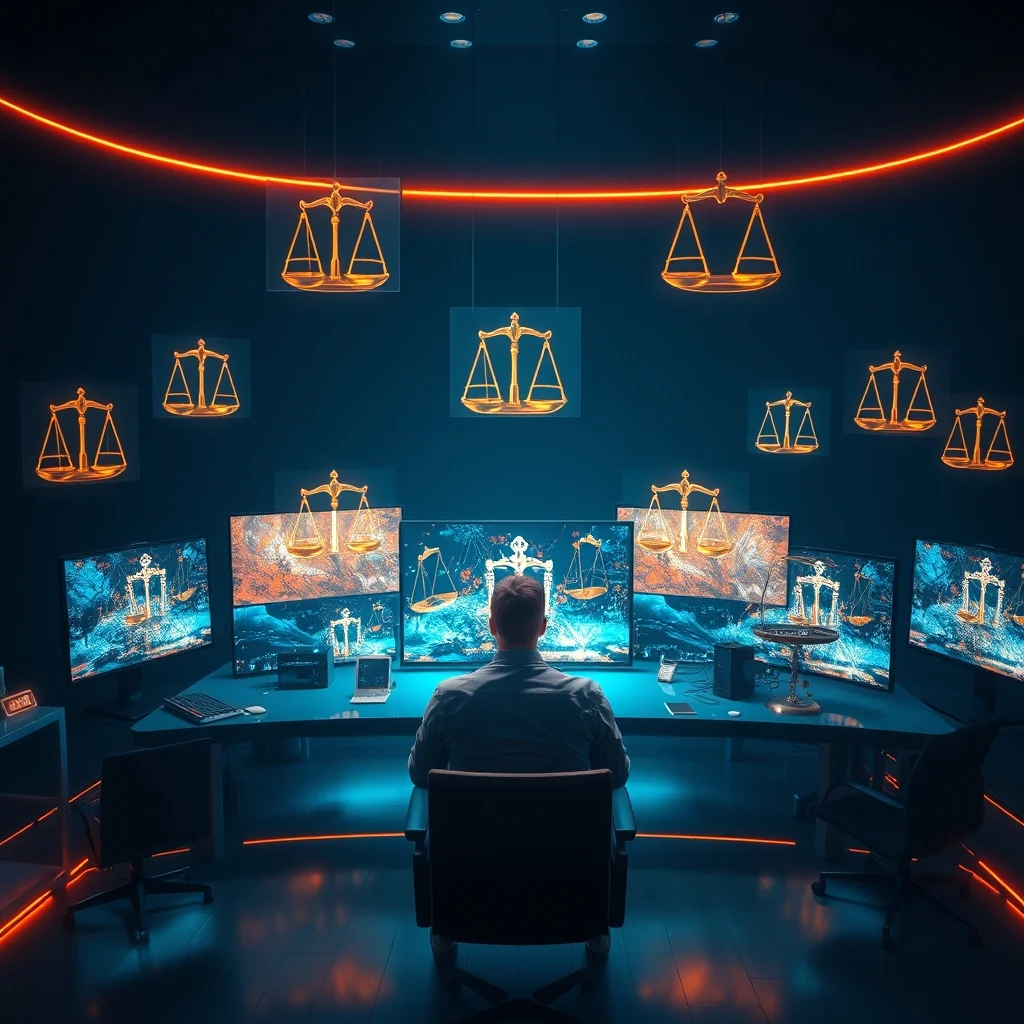

The digital landscape is undergoing a seismic shift driven by artificial intelligence. At the forefront of this revolution is the emergence of AI-generated art, a phenomenon that challenges our fundamental understanding of creativity, ownership, and intellectual property. Platforms like Midjourney and DALL-E have democratized image creation, allowing users to produce stunning visuals from simple text prompts. However, this technological leap has ignited a firestorm of legal challenges and ethical dilemmas that threaten to reshape the creative industries. This article examines the disputes, ethical concerns, and industry responses surrounding this burgeoning field.
We explore the impact on traditional artists, the evolving legal frameworks, and the uncertain future of AI in creative industries. The problem at hand is not merely technical but deeply philosophical and legal. It questions who owns a creation made by a machine trained on human work without explicit permission. The promise of this technology is immense speed and accessibility, but the cost involves potential displacement of human labor and legal ambiguity. Readers will gain a comprehensive understanding of the current climate and what to expect in the coming years.
🚀 Overview of the AI Art Revolution
AI art generators represent a convergence of advanced machine learning algorithms and creative expression. These tools use deep learning models to interpret text descriptions and generate corresponding images. The current significance of this technology lies in its ability to bypass traditional barriers to entry in the visual arts. Previously, creating high-quality imagery required years of training in drawing, painting, or digital design. Now, a user with a smartphone can generate complex artwork in seconds. This accessibility has led to an explosion of content, changing how media is consumed and produced.
The problem it solves is efficiency. Marketing agencies, game developers, and individual creators can now prototype ideas rapidly without hiring expensive illustrators. However, this efficiency comes with a heavy price tag regarding copyright law. The core issue is the training data used to build these models. Most generators are trained on billions of images scraped from the internet, many of which are copyrighted. This raises the question of whether the AI is mimicking styles or directly copying intellectual property. We will delve into the specific legal battles and ethical frameworks that define this new era.
🎯 Analysis of the Current Landscape
The current landscape of AI art is defined by a tug-of-war between innovation and regulation. Tech giants push for rapid deployment and monetization, while artists demand protection for their livelihoods and styles. The search intent behind this topic is high because creators want to know if they can use AI tools without facing lawsuits. The market relevance is undeniable, with billions of dollars at stake in the software sector and the creative services market. Future outlook suggests a regulatory crackdown is inevitable as governments attempt to balance innovation with worker protection.
- Technical background explains how diffusion models learn patterns from existing art.
- Why users search for this topic centers on fear of job loss and legal liability.
- Market or industry relevance includes the gaming, advertising, and publishing sectors.
- Future outlook involves potential legislation and opt-in training data systems.
🛠️ Understanding AI Art Generators
📊 What is AI Art Technology?
AI art technology refers to software that utilizes artificial intelligence to create visual content. The primary function is to translate natural language prompts into high-fidelity images. Target users include digital artists, marketers, hobbyists, and commercial enterprises. The technical category falls under generative adversarial networks and diffusion models. These systems do not simply retrieve images; they synthesize new pixels based on learned statistical patterns. This mechanism allows for infinite variation, though it can also lead to uncanny valley effects.
- Core definition is a generative model trained on image-text pairs.
- Primary function is text-to-image synthesis.
- Target users are anyone with internet access and a prompt.
- Technical category is Machine Learning and Computer Vision.
⚙️ How Does the Technology Work?
The technical architecture relies on massive datasets containing billions of images and their descriptions. The model learns to associate specific words with visual features, such as the color blue or the shape of a tree. When a prompt is entered, the system iteratively refines noise into a coherent image that matches the description. This process involves complex mathematical operations that are not fully transparent to the public. Practical examples include generating a portrait of a cat in a specific artistic style or creating a background for a video game.
Internal processes involve encoding the text into vectors and decoding them into pixel data. The system evaluates the output against its training data to ensure it aligns with the prompt. This iterative refinement can take several seconds or minutes depending on the hardware. Users often tweak prompts to achieve the desired aesthetic, demonstrating the interactive nature of the technology. The result is a new image that did not exist prior to the generation process.
🚀 Key Features and Advanced Capabilities
✨ Core Functionalities
The key features of modern AI art tools include style transfer, upscaling, and in-painting. Real-world use cases range from concept art for movies to quick social media graphics. Advanced capabilities allow for consistent character generation across multiple images, which is crucial for storytelling. Practical applications extend to architectural visualization and fashion design. These tools are evolving rapidly, with updates introducing video generation and 3D model creation.
- Style Transfer: Mimics the technique of specific painters.
- High Resolution: Upscales images to print-ready quality.
- Consistency: Maintains character likeness across scenes.
- Editing: Allows selective changes to generated images.
📊 Key Metrics and Data Analysis
The following table summarizes the major players in the AI art market and their general standing. This data highlights the competitive landscape and the varying approaches to copyright handling.
| Feature | Midjourney | DALL-E 3 | Stable Diffusion |
|---|---|---|---|
| Accessibility | Discord Based | API and Web | Self Hosted |
| Quality | Very High | High | Variable |
| Copyright | Commercial Rights | Restricted | Open Weights |
| Cost | Subscription | Subscription | Free or Paid |
Analyzing this table reveals distinct strategies for user engagement and monetization. Midjourney focuses on quality and community, while DALL-E integrates deeply with Microsoft ecosystems. Stable Diffusion offers control but requires technical expertise. Users must weigh these factors when choosing a platform. The copyright column is particularly critical, as it determines commercial viability. Understanding these metrics helps artists navigate the legal risks associated with each tool.
🆚 What Distinguishes It from Competitors
AI art distinguishes itself from traditional digital art through speed and the absence of manual brushwork. While traditional art relies on the skill of the human hand, AI relies on the accuracy of the algorithm. The competitive difference lies in the training data sources and the output licenses. Some platforms allow commercial use of generated images, while others retain rights. This strategic positioning creates a fragmented market where legal safety varies by tool.
- Speed: AI generates in seconds versus hours for humans.
- Cost: AI is cheaper for bulk production.
- Control: Humans have total control over details.
- Originality: AI synthesizes existing concepts.
📊 Pros and Cons of AI Art
✅ Advantages
The advantages of AI art are primarily economic and logistical. It allows for rapid prototyping and cost reduction in the creative process. Artists can use it as a brainstorming tool to overcome creative blocks. The technology also makes art accessible to those without formal training. This democratization is a significant positive impact on the global creative economy.
- ✅ Rapid Iteration: Test multiple ideas quickly.
- ✅ Cost Efficiency: Reduce production expenses.
- ✅ Accessibility: Democratizes image creation.
- ✅ Inspiration: Overcomes creative block.
❌ Disadvantages
The disadvantages center on ethical concerns and potential legal liabilities. There is a risk of homogenization where all art looks similar due to shared training data. Artists may feel their work is stolen without compensation. Furthermore, the lack of copyright protection for AI output in some jurisdictions creates uncertainty. It is not suitable for creators who prioritize human-centric value propositions.
- ❌ Legal Uncertainty: Copyright status is unclear.
- ❌ Ethical Issues: Training data consent is questioned.
- ❌ Job Displacement: Threatens entry-level positions.
- ❌ Quality Variance: Errors are common.
🔐 Legal and Ethical Security
🔒 Security Level and Risks
The security level of AI art platforms varies regarding data privacy and output rights. Potential risks include unintentional copyright infringement and exposure of private data. Users must understand that generated images may contain recognizable elements of copyrighted works. Protection tips include avoiding prompts that reference living artists and checking license terms carefully.
- 🛑 Risk: Infringement of existing copyrights.
- 🛑 Risk: Privacy breaches in training sets.
- 🛑 Tip: Use licensed training data tools.
- 🛑 Tip: Review commercial license agreements.
📈 Performance and Adoption
🎮 Real Performance Experience
Real performance experience is measured by output quality and generation speed. Resource usage can be high, requiring powerful GPUs for local models. Stability has improved significantly with each update. Users report fewer glitches and more accurate prompt adherence. The technology is becoming increasingly reliable for professional workflows.
🌍 Global User Ratings
Global user ratings indicate high satisfaction with the technology’s capabilities. Positive feedback reasons include ease of use and impressive visual results. Negative feedback reasons focus on copyright issues and occasional hallucinations. Trend analysis shows a shift towards platforms with clearer legal terms. Users are becoming more cautious about where they generate content.
- 1) Average rating is high across major platforms.
- 2) Positive feedback reasons are speed and quality.
- 3) Negative feedback reasons are legal ambiguity.
- 4) Trend analysis points to regulatory compliance.
🛠️ Practical Implementation Guide
🧩 Setup and Usage Method
Setting up an AI art workflow involves choosing a platform and understanding its interface. Step-by-step instructions ensure users can start generating safely. Each step must be followed to avoid common pitfalls. Detailed explanations are provided to guide the setup process.
- 1) Select a platform that meets your legal needs.
- 2) Create an account and verify your identity.
- 3) Learn the specific syntax for prompts.
- 4) Test with simple images before complex projects.
🛡️ Common Errors and Fixes
Common errors include distorted faces or nonsensical text. These issues are often fixed by adjusting the prompt or using upscaling tools. Technical fixes involve tweaking parameters like guidance scale. Users should maintain a log of successful prompts to replicate results.
- ⚠️ Issue: Distorted hands.
- ⚠️ Fix: Use in-painting to correct.
- ⚠️ Issue: Text gibberish.
- ⚠️ Fix: Simplify the prompt description.
💡 Tips for Creators and Users
🎯 Best Settings for Maximum Performance
Best settings for performance involve balancing quality and speed. Recommended configurations include higher sampling steps for detail. Adjusting the seed can help achieve consistency. Practical analysis suggests testing different models to find the best fit.
- ✅ High sampling steps for detail.
- ✅ Stable seed for consistency.
- ✅ Negative prompts to avoid errors.
- ✅ Upscaling for final output.
📌 Advanced Tricks Few Know
Advanced tricks involve chaining multiple generations to refine an image. This process is known as image-to-image generation. It allows for greater control over the final composition. Experienced users combine AI with traditional editing software for best results.
🏁 Final Verdict
The rise of AI-generated art is a pivotal moment in creative history. It offers unprecedented opportunities but carries significant risks. A clear recommendation is to use these tools as assistive devices rather than replacements. The future of AI in creative industries depends on resolving the legal and ethical debates. Users must stay informed about changing laws and platform terms.
Call to action: Evaluate your current workflow and consider the ethical implications of your tools. The balance between innovation and integrity will define the next decade of digital art.
❓ Frequently Asked Questions
- 1) Can I copyright AI generated art? No, currently US law requires human authorship.
- 2) Is it illegal to use AI art generators? No, but using them may infringe on others’ rights.
- 3) Do artists get paid when their work trains AI? Generally no, unless specific programs exist.
- 4) Which AI art tool is safest legally? Check license terms for commercial rights.
- 5) Can AI art replace human artists? Not entirely, but it threatens entry-level roles.
- 6) How do I protect my style from AI? Watermarking and opt-out lists help.
- 7) Will AI art laws change in 2026? Regulations are expected to tighten significantly.
- 8) Is Stable Diffusion safer than Midjourney? It depends on deployment and usage.
- 9) What happens if I generate infringing content? You could be liable for damages.
- 10) Should I start an AI art business? Proceed with caution and legal counsel.