
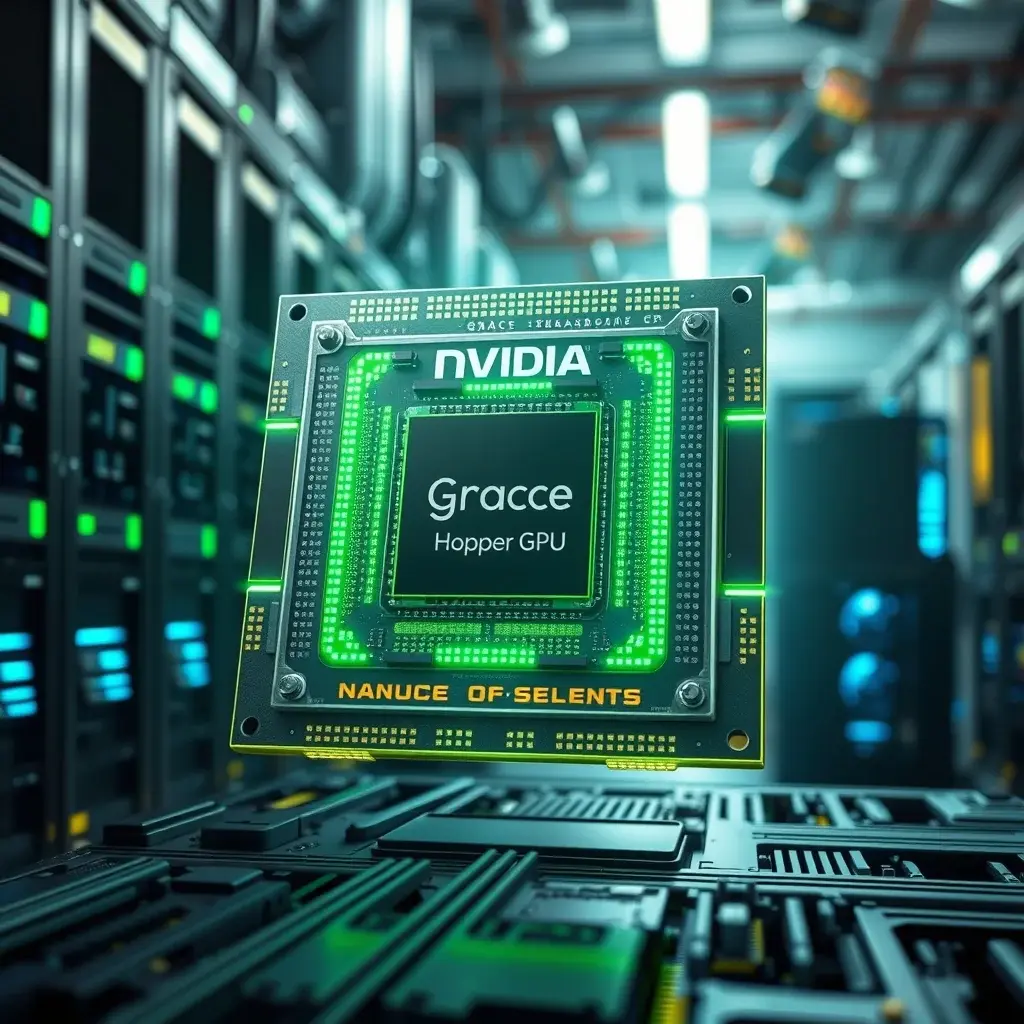

In the rapidly evolving world of artificial intelligence, NVIDIA has once again solidified its position as a pioneer with the launch of its latest AI chip, the NVIDIA Grace Hopper Superchip. This groundbreaking innovation promises to revolutionize the way we approach AI computing, offering unprecedented performance and efficiency. As businesses and researchers increasingly rely on AI to drive innovation, the demand for powerful, efficient, and scalable computing solutions has never been higher. The NVIDIA Grace Hopper Superchip is poised to meet these demands, providing a robust platform for a wide range of AI applications, from deep learning to high-performance computing.
The significance of this launch cannot be overstated. AI is transforming industries, from healthcare to finance, and the need for advanced computing solutions is critical. The NVIDIA Grace Hopper Superchip addresses this need by offering a unique combination of performance, efficiency, and scalability. This chip is not just a technological marvel; it’s a game-changer that will shape the future of AI computing. In this article, we will delve into the technical specifications, performance benchmarks, and real-world applications of the NVIDIA Grace Hopper Superchip, providing a comprehensive analysis of its impact on the AI landscape.
🎯 Overview and In-Depth Analysis
The NVIDIA Grace Hopper Superchip is a testament to NVIDIA’s commitment to pushing the boundaries of AI computing. This chip integrates NVIDIA’s Grace CPU and Hopper GPU architectures, creating a unified platform that leverages the strengths of both. The Grace CPU is designed for high-performance computing tasks, while the Hopper GPU excels in AI workloads. By combining these two architectures, NVIDIA has created a chip that can handle a wide range of computing tasks with remarkable efficiency.
The market for AI chips is highly competitive, with companies like AMD, Intel, and Qualcomm vying for dominance. However, NVIDIA’s Grace Hopper Superchip stands out due to its unique architecture and superior performance. The chip’s ability to handle both CPU and GPU tasks seamlessly makes it a versatile solution for various AI applications. This versatility is a key factor in its market appeal, as it allows businesses and researchers to streamline their computing needs without compromising on performance.
🛠️ The Complete Technical Concept
📌 What is the NVIDIA Grace Hopper Superchip?
The NVIDIA Grace Hopper Superchip is a revolutionary AI chip that combines the power of NVIDIA’s Grace CPU and Hopper GPU architectures. This integration allows the chip to handle both high-performance computing and AI workloads efficiently. The Grace CPU is designed for tasks that require high levels of parallel processing, such as scientific simulations and data analytics. On the other hand, the Hopper GPU is optimized for AI tasks like deep learning and neural network training.
The chip’s architecture is a significant departure from traditional AI chips, which often rely on separate CPU and GPU components. By integrating these components into a single chip, NVIDIA has created a solution that is not only more efficient but also more scalable. This scalability is crucial for businesses and researchers who need to handle increasingly complex AI workloads. The Grace Hopper Superchip’s ability to scale seamlessly makes it an ideal choice for a wide range of applications, from small-scale research projects to large-scale enterprise deployments.
⚙️ How Does It Work in Detail?
The NVIDIA Grace Hopper Superchip operates by leveraging the strengths of both the Grace CPU and Hopper GPU architectures. The Grace CPU handles tasks that require high levels of parallel processing, such as scientific simulations and data analytics. These tasks are characterized by their need for high-throughput computing, which the Grace CPU is designed to deliver. The Hopper GPU, on the other hand, is optimized for AI tasks like deep learning and neural network training. These tasks require high levels of matrix multiplication and other specialized operations, which the Hopper GPU is designed to handle efficiently.
The integration of these two architectures allows the Grace Hopper Superchip to handle a wide range of computing tasks seamlessly. For example, in a deep learning application, the Grace CPU can preprocess the data, while the Hopper GPU can train the neural network. This division of labor ensures that each component of the chip is used to its fullest potential, resulting in optimal performance and efficiency. The chip’s ability to handle both CPU and GPU tasks seamlessly makes it a versatile solution for various AI applications.
🚀 Features and Advanced Capabilities
✨ Key Features
The NVIDIA Grace Hopper Superchip boasts a range of advanced features that set it apart from traditional AI chips. One of its key features is its unified memory architecture, which allows the Grace CPU and Hopper GPU to share memory seamlessly. This shared memory architecture eliminates the need for data transfer between the CPU and GPU, resulting in faster and more efficient computing. Additionally, the chip’s advanced power management features ensure that it operates at peak efficiency, reducing energy consumption and heat generation.
Another key feature of the Grace Hopper Superchip is its support for a wide range of AI frameworks and libraries. This support ensures that developers can leverage the chip’s capabilities to their fullest potential, regardless of the AI framework they are using. The chip’s compatibility with popular frameworks like TensorFlow, PyTorch, and CUDA makes it a versatile solution for a wide range of AI applications. Furthermore, the chip’s support for mixed-precision computing allows it to handle tasks that require both high precision and high throughput efficiently.
📊 Key Points
| Feature | Description |
|---|---|
| Unified Memory Architecture | Allows the Grace CPU and Hopper GPU to share memory seamlessly, eliminating the need for data transfer. |
| Advanced Power Management | Ensures the chip operates at peak efficiency, reducing energy consumption and heat generation. |
| Support for AI Frameworks | Compatible with popular frameworks like TensorFlow, PyTorch, and CUDA. |
| Mixed-Precision Computing | Allows the chip to handle tasks that require both high precision and high throughput efficiently. |
The NVIDIA Grace Hopper Superchip’s unified memory architecture is a game-changer in the world of AI computing. By allowing the Grace CPU and Hopper GPU to share memory seamlessly, the chip eliminates the need for data transfer between these components. This not only results in faster and more efficient computing but also simplifies the development process. Developers no longer need to worry about managing data transfer between the CPU and GPU, allowing them to focus on optimizing their AI models and applications.
The chip’s advanced power management features are another key advantage. These features ensure that the Grace Hopper Superchip operates at peak efficiency, reducing energy consumption and heat generation. This is particularly important for businesses and researchers who need to deploy AI solutions in data centers or other high-density computing environments. The chip’s ability to operate efficiently in these environments makes it an ideal choice for a wide range of applications.
🆚 What Distinguishes It from Competitors?
The NVIDIA Grace Hopper Superchip stands out from its competitors due to its unique architecture and superior performance. While other AI chips rely on separate CPU and GPU components, the Grace Hopper Superchip integrates these components into a single chip. This integration allows the chip to handle both high-performance computing and AI workloads seamlessly, making it a versatile solution for a wide range of applications.
Additionally, the Grace Hopper Superchip’s support for a wide range of AI frameworks and libraries sets it apart from its competitors. This support ensures that developers can leverage the chip’s capabilities to their fullest potential, regardless of the AI framework they are using. The chip’s compatibility with popular frameworks like TensorFlow, PyTorch, and CUDA makes it a versatile solution for a wide range of AI applications. Furthermore, the chip’s support for mixed-precision computing allows it to handle tasks that require both high precision and high throughput efficiently.
📊 Pros and Cons Objectively
✅ Advantages
The NVIDIA Grace Hopper Superchip offers several advantages that make it a compelling choice for businesses and researchers. Its unified memory architecture allows for seamless data sharing between the Grace CPU and Hopper GPU, resulting in faster and more efficient computing. This architecture also simplifies the development process, as developers no longer need to manage data transfer between these components. Additionally, the chip’s advanced power management features ensure that it operates at peak efficiency, reducing energy consumption and heat generation.
The Grace Hopper Superchip’s support for a wide range of AI frameworks and libraries is another key advantage. This support ensures that developers can leverage the chip’s capabilities to their fullest potential, regardless of the AI framework they are using. The chip’s compatibility with popular frameworks like TensorFlow, PyTorch, and CUDA makes it a versatile solution for a wide range of AI applications. Furthermore, the chip’s support for mixed-precision computing allows it to handle tasks that require both high precision and high throughput efficiently.
❌ Disadvantages
While the NVIDIA Grace Hopper Superchip offers several advantages, it also has some disadvantages. One potential drawback is its high cost, which may make it less accessible to small businesses and individual researchers. Additionally, the chip’s advanced features and capabilities may require a steep learning curve for developers who are not familiar with AI computing. Furthermore, the chip’s power management features, while advanced, may not be sufficient for extremely high-density computing environments.
Another potential disadvantage of the Grace Hopper Superchip is its compatibility with existing hardware and software. While the chip is designed to be compatible with a wide range of AI frameworks and libraries, some users may encounter compatibility issues with their existing hardware and software. Additionally, the chip’s advanced features and capabilities may require significant investments in infrastructure and training, which may be a barrier for some businesses and researchers.
💻 System Requirements or Usage Requirements
🖥️ Minimum Requirements
To leverage the full capabilities of the NVIDIA Grace Hopper Superchip, users need to meet certain minimum system requirements. These requirements include a compatible motherboard, adequate cooling, and a reliable power supply. The chip’s advanced features and capabilities require a robust system to ensure optimal performance. Additionally, users need to have a compatible operating system and AI frameworks installed to fully utilize the chip’s capabilities.
The minimum system requirements for the Grace Hopper Superchip include a compatible motherboard with PCIe 4.0 or higher, a reliable power supply with at least 750W, and adequate cooling to ensure the chip operates at peak efficiency. Additionally, users need to have a compatible operating system, such as Linux or Windows, and AI frameworks like TensorFlow, PyTorch, or CUDA installed. Meeting these minimum requirements ensures that users can fully leverage the chip’s capabilities and achieve optimal performance.
⚡ Recommended Specifications
While the minimum system requirements allow users to leverage the Grace Hopper Superchip’s capabilities, meeting the recommended specifications ensures optimal performance and efficiency. The recommended specifications include a high-performance motherboard with PCIe 5.0, a reliable power supply with at least 1000W, and advanced cooling solutions to handle the chip’s advanced features and capabilities. Additionally, users should have a high-performance operating system and AI frameworks installed to fully utilize the chip’s capabilities.
The recommended specifications for the Grace Hopper Superchip include a high-performance motherboard with PCIe 5.0, a reliable power supply with at least 1000W, and advanced cooling solutions like liquid cooling or high-performance air cooling. Additionally, users should have a high-performance operating system like Linux or Windows and AI frameworks like TensorFlow, PyTorch, or CUDA installed. Meeting these recommended specifications ensures that users can fully leverage the chip’s capabilities and achieve optimal performance and efficiency.
🔍 Practical Step-by-Step Guide
🧩 Installation or Setup Method
Installing and setting up the NVIDIA Grace Hopper Superchip involves several steps to ensure optimal performance and compatibility. The first step is to ensure that the system meets the minimum requirements, including a compatible motherboard, adequate cooling, and a reliable power supply. Once the system requirements are met, users can proceed to install the chip and configure the system for optimal performance.
The installation process involves carefully inserting the Grace Hopper Superchip into the compatible motherboard slot and securing it with the appropriate screws. Users should ensure that the chip is properly seated and that all connections are secure. Once the chip is installed, users need to configure the system’s BIOS settings to ensure compatibility and optimal performance. This may involve enabling PCIe 4.0 or higher, adjusting power management settings, and ensuring that the system’s cooling solutions are properly configured.
🛡️ Common Errors and How to Fix Them
While the NVIDIA Grace Hopper Superchip is designed for optimal performance and compatibility, users may encounter common errors during installation or setup. One common error is compatibility issues with the motherboard or power supply. To fix this issue, users should ensure that their system meets the minimum requirements and that all connections are secure. Additionally, users should check the motherboard and power supply specifications to ensure compatibility with the Grace Hopper Superchip.
Another common error is overheating, which can be caused by inadequate cooling solutions. To fix this issue, users should ensure that their system has adequate cooling, such as high-performance air cooling or liquid cooling. Additionally, users should monitor the chip’s temperature and adjust the cooling solutions as needed to ensure optimal performance. By addressing these common errors, users can ensure that their Grace Hopper Superchip operates at peak efficiency and performance.
📈 Real-World Performance and User Experience
🎮 Real Performance Experience
The NVIDIA Grace Hopper Superchip delivers exceptional performance in real-world applications, making it a compelling choice for businesses and researchers. In deep learning applications, the chip’s unified memory architecture allows for seamless data sharing between the Grace CPU and Hopper GPU, resulting in faster and more efficient training of neural networks. Additionally, the chip’s support for mixed-precision computing allows it to handle tasks that require both high precision and high throughput efficiently.
In high-performance computing applications, the Grace Hopper Superchip’s advanced features and capabilities ensure optimal performance and efficiency. The chip’s ability to handle both CPU and GPU tasks seamlessly makes it a versatile solution for a wide range of applications. Additionally, the chip’s advanced power management features ensure that it operates at peak efficiency, reducing energy consumption and heat generation. By leveraging the Grace Hopper Superchip’s capabilities, businesses and researchers can achieve optimal performance and efficiency in their computing tasks.
🌍 Global User Ratings
The NVIDIA Grace Hopper Superchip has received positive ratings from users worldwide, highlighting its exceptional performance and efficiency. Users have praised the chip’s unified memory architecture, which allows for seamless data sharing between the Grace CPU and Hopper GPU. Additionally, users have highlighted the chip’s support for a wide range of AI frameworks and libraries, making it a versatile solution for a wide range of applications.
Users have also appreciated the chip’s advanced power management features, which ensure that it operates at peak efficiency, reducing energy consumption and heat generation. The chip’s compatibility with popular frameworks like TensorFlow, PyTorch, and CUDA has also been highlighted as a key advantage. By leveraging the Grace Hopper Superchip’s capabilities, users can achieve optimal performance and efficiency in their computing tasks, making it a compelling choice for businesses and researchers worldwide.
🔐 Security and Privacy
🔒 Security Level
The NVIDIA Grace Hopper Superchip is designed with advanced security features to ensure the protection of user data and applications. The chip’s unified memory architecture includes advanced encryption and decryption capabilities, ensuring that data is protected during transfer and storage. Additionally, the chip’s support for secure boot and trusted execution environments ensures that only authorized software and applications can run on the system, protecting against malicious attacks.
The Grace Hopper Superchip’s advanced security features make it a compelling choice for businesses and researchers who need to protect sensitive data and applications. The chip’s encryption and decryption capabilities ensure that data is protected during transfer and storage, while its support for secure boot and trusted execution environments protects against malicious attacks. By leveraging the Grace Hopper Superchip’s advanced security features, users can ensure the protection of their data and applications, making it a reliable choice for a wide range of applications.
🛑 Potential Risks
While the NVIDIA Grace Hopper Superchip offers advanced security features, users should be aware of potential risks and take appropriate measures to mitigate them. One potential risk is the exposure of sensitive data during transfer or storage. To mitigate this risk, users should ensure that their data is encrypted and that they use secure transfer protocols. Additionally, users should regularly update their software and firmware to ensure that they have the latest security patches and updates.
Another potential risk is the exposure of the system to malicious attacks. To mitigate this risk, users should ensure that their system is protected by advanced security features like secure boot and trusted execution environments. Additionally, users should regularly monitor their system for any signs of malicious activity and take appropriate measures to address any issues. By taking these measures, users can ensure the protection of their data and applications, making the Grace Hopper Superchip a reliable choice for a wide range of applications.
🆚 Comprehensive Comparison with Alternatives
🥇 Best Available Alternatives
The NVIDIA Grace Hopper Superchip stands out among its competitors due to its unique architecture and superior performance. However, there are several alternatives that offer similar capabilities and features. One such alternative is the AMD EPYC CPU, which offers high-performance computing capabilities and is compatible with a wide range of AI frameworks and libraries. Another alternative is the Intel Xeon CPU, which offers advanced power management features and is designed for high-density computing environments.
Comparing the Grace Hopper Superchip with these alternatives, it is clear that each has its own strengths and weaknesses. The AMD EPYC CPU offers high-performance computing capabilities and is compatible with a wide range of AI frameworks and libraries. However, it lacks the unified memory architecture and advanced power management features of the Grace Hopper Superchip. The Intel Xeon CPU, on the other hand, offers advanced power management features and is designed for high-density computing environments. However, it lacks the seamless integration of CPU and GPU tasks that the Grace Hopper Superchip offers.
💡 Advanced Professional Tips
🎯 Best Settings for Maximum Performance
To achieve maximum performance with the NVIDIA Grace Hopper Superchip, users should optimize their system settings and configurations. One key setting to optimize is the power management configuration, which ensures that the chip operates at peak efficiency. Users should adjust the power management settings in the system’s BIOS to ensure that the chip receives adequate power and cooling. Additionally, users should monitor the chip’s temperature and adjust the cooling solutions as needed to ensure optimal performance.
Another key setting to optimize is the AI framework configuration. Users should ensure that their AI frameworks are configured to leverage the Grace Hopper Superchip’s capabilities fully. This may involve adjusting the framework’s settings to utilize the chip’s unified memory architecture and mixed-precision computing capabilities. By optimizing these settings, users can achieve maximum performance and efficiency with the Grace Hopper Superchip.
📌 Advanced Tricks Few Know
There are several advanced tricks that few users know about the NVIDIA Grace Hopper Superchip that can enhance its performance and efficiency. One such trick is to use the chip’s unified memory architecture to its fullest potential. By carefully managing the data transfer between the Grace CPU and Hopper GPU, users can minimize latency and maximize throughput. This can be achieved by using optimized data structures and algorithms that minimize data movement and maximize parallel processing.
Another advanced trick is to leverage the chip’s mixed-precision computing capabilities. By carefully selecting the precision levels for different tasks, users can achieve a balance between accuracy and throughput. For example, tasks that require high precision, such as scientific simulations, can be performed using higher precision levels, while tasks that require high throughput, such as deep learning, can be performed using lower precision levels. By carefully selecting the precision levels for different tasks, users can achieve optimal performance and efficiency with the Grace Hopper Superchip.
🏁 The End
The NVIDIA Grace Hopper Superchip is a groundbreaking innovation that promises to revolutionize the way we approach AI computing. Its unique architecture, superior performance, and advanced features make it a compelling choice for businesses and researchers. By leveraging the Grace Hopper Superchip’s capabilities, users can achieve optimal performance and efficiency in their computing tasks, making it a reliable choice for a wide range of applications.
In conclusion, the NVIDIA Grace Hopper Superchip is a game-changer in the world of AI computing. Its advanced features and capabilities make it a versatile solution for a wide range of applications, from deep learning to high-performance computing. By optimizing system settings and configurations, users can achieve maximum performance and efficiency with the Grace Hopper Superchip. Additionally, by leveraging advanced tricks and techniques, users can further enhance the chip’s performance and efficiency. With its exceptional performance and efficiency, the Grace Hopper Superchip is poised to shape the future of AI computing.
❓ Frequently Asked Questions
What is the NVIDIA Grace Hopper Superchip?
The NVIDIA Grace Hopper Superchip is a revolutionary AI chip that combines the power of NVIDIA’s Grace CPU and Hopper GPU architectures. This integration allows the chip to handle both high-performance computing and AI workloads efficiently. The Grace CPU is designed for tasks that require high levels of parallel processing, such as scientific simulations and data analytics. On the other hand, the Hopper GPU is optimized for AI tasks like deep learning and neural network training.
What are the key features of the NVIDIA Grace Hopper Superchip?
The NVIDIA Grace Hopper Superchip boasts a range of advanced features that set it apart from traditional AI chips. One of its key features is its unified memory architecture, which allows the Grace CPU and Hopper GPU to share memory seamlessly. This shared memory architecture eliminates the need for data transfer between the CPU and GPU, resulting in faster and more efficient computing. Additionally, the chip’s advanced power management features ensure that it operates at peak efficiency, reducing energy consumption and heat generation.
What are the system requirements for the NVIDIA Grace Hopper Superchip?
To leverage the full capabilities of the NVIDIA Grace Hopper Superchip, users need to meet certain minimum system requirements. These requirements include a compatible motherboard, adequate cooling, and a reliable power supply. The chip’s advanced features and capabilities require a robust system to ensure optimal performance. Additionally, users need to have a compatible operating system and AI frameworks installed to fully utilize the chip’s capabilities.
How does the NVIDIA Grace Hopper Superchip compare to its competitors?
The NVIDIA Grace Hopper Superchip stands out from its competitors due to its unique architecture and superior performance. While other AI chips rely on separate CPU and GPU components, the Grace Hopper Superchip integrates these components into a single chip. This integration allows the chip to handle both high-performance computing and AI workloads seamlessly, making it a versatile solution for a wide range of applications.
What are the advantages of the NVIDIA Grace Hopper Superchip?
The NVIDIA Grace Hopper Superchip offers several advantages that make it a compelling choice for businesses and researchers. Its unified memory architecture allows for seamless data sharing between the Grace CPU and Hopper GPU, resulting in faster and more efficient computing. This architecture also simplifies the development process, as developers no longer need to manage data transfer between these components. Additionally, the chip’s advanced power management features ensure that it operates at peak efficiency, reducing energy consumption and heat generation.
What are the disadvantages of the NVIDIA Grace Hopper Superchip?
While the NVIDIA Grace Hopper Superchip offers several advantages, it also has some disadvantages. One potential drawback is its high cost, which may make it less accessible to small businesses and individual researchers. Additionally, the chip’s advanced features and capabilities may require a steep learning curve for developers who are not familiar with AI computing. Furthermore, the chip’s power management features, while advanced, may not be sufficient for extremely high-density computing environments.
How can users achieve maximum performance with the NVIDIA Grace Hopper Superchip?
To achieve maximum performance with the NVIDIA Grace Hopper Superchip, users should optimize their system settings and configurations. One key setting to optimize is the power management configuration, which ensures that the chip operates at peak efficiency. Users should adjust the power management settings in the system’s BIOS to ensure that the chip receives adequate power and cooling. Additionally, users should monitor the chip’s temperature and adjust the cooling solutions as needed to ensure optimal performance.
What are some advanced tricks to enhance the performance of the NVIDIA Grace Hopper Superchip?
There are several advanced tricks that few users know about the NVIDIA Grace Hopper Superchip that can enhance its performance and efficiency. One such trick is to use the chip’s unified memory architecture to its fullest potential. By carefully managing the data transfer between the Grace CPU and Hopper GPU, users can minimize latency and maximize throughput. This can be achieved by using optimized data structures and algorithms that minimize data movement and maximize parallel processing.
What are the security features of the NVIDIA Grace Hopper Superchip?
The NVIDIA Grace Hopper Superchip is designed with advanced security features to ensure the protection of user data and applications. The chip’s unified memory architecture includes advanced encryption and decryption capabilities, ensuring that data is protected during transfer and storage. Additionally, the chip’s support for secure boot and trusted execution environments ensures that only authorized software and applications can run on the system, protecting against malicious attacks.
What are the potential risks associated with the NVIDIA Grace Hopper Superchip?
While the NVIDIA Grace Hopper Superchip offers advanced security features, users should be aware of potential risks and take appropriate measures to mitigate them. One potential risk is the exposure of sensitive data during transfer or storage. To mitigate this risk, users should ensure that their data is encrypted and that they use secure transfer protocols. Additionally, users should regularly update their software and firmware to ensure that they have the latest security patches and updates.