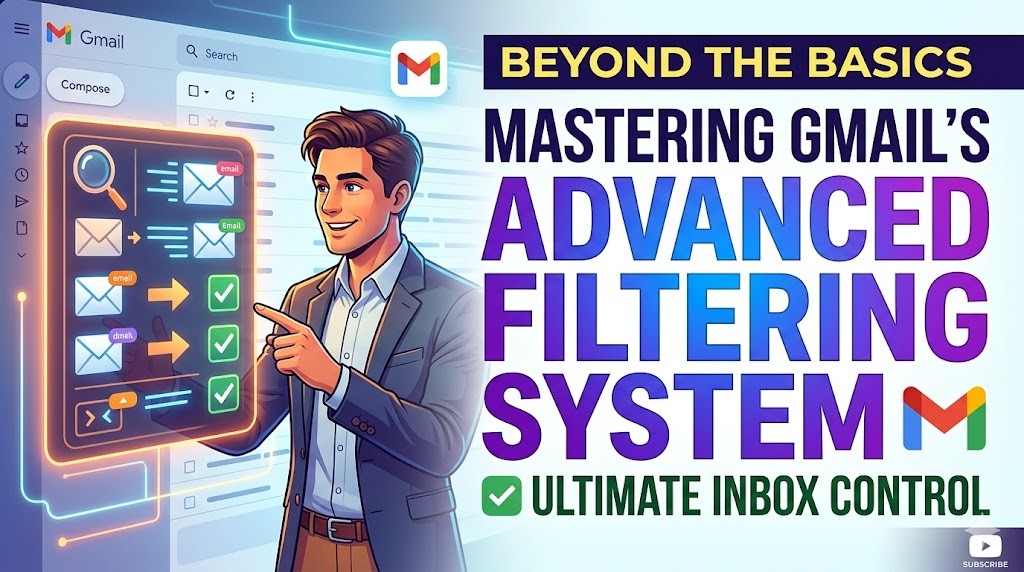

In the digital age, managing email has become one of the most critical skills for professionals and students alike. While most users rely on basic sorting, the true power lies in Gmail’s advanced filtering capabilities. This comprehensive guide explores how to harness these tools to transform your inbox from a chaotic mess into a streamlined workflow. By mastering these features, you gain the ability to automate organization, reduce clutter, and focus on what truly matters.
Gmail is not merely a communication tool; it is an intelligent platform capable of understanding and processing complex conditions. The standard interface hides advanced options that, when unlocked, offer unprecedented control over your digital correspondence. Whether you are dealing with high volumes of newsletters, urgent client emails, or potential spam, the filtering system provides a structured method to handle them efficiently. This article will take you beyond the surface level to reveal the mechanics of advanced search syntax and conditional logic.
🧠 Understanding the Ecosystem and Search Intent
Before diving into the technical configurations, it is essential to understand why this feature matters in the current landscape of digital communication. The average user receives hundreds of emails weekly, and without automation, this volume leads to stress and missed opportunities. The intent behind searching for these advanced tools is to reclaim time and mental clarity.
- 1)
- Technical background regarding how Gmail parses incoming data
- 2)
- Why users search for this topic to improve productivity
- 3)
- Market relevance of email management in 2026
- 4)
- Future outlook of AI-driven inbox organization
🛠️ Technical Concept and Core Definitions
📘 What is the Gmail Filter System?
The Gmail filter system is a backend processing mechanism that evaluates incoming messages against a set of predefined rules. Unlike simple folder sorting, filters can execute actions such as archiving, labeling, forwarding, or even deleting messages before they reach your primary view. This system operates on a server-side basis, meaning the processing happens before the email is downloaded to your device.
- Core definition: Automated rules for incoming mail
- Primary function: Sorting and actioning messages based on criteria
- Target users: Professionals, students, and anyone with high email volume
- Technical category: Email client automation and server-side processing
⚙️ How Does It Work in Detail?
When an email arrives at the Gmail servers, the system scans the header and body content against your active filter rules. This process involves matching specific fields such as the sender address, subject line, or keywords within the text. If a match is found, the associated actions are triggered immediately. This architecture ensures that your inbox remains clean in real-time without manual intervention.
The internal processes involve a logic gate system where multiple conditions can be combined. For example, you can specify that an email must come from a specific sender AND must contain a specific attachment. This conditional logic allows for highly granular control over your communication flow, ensuring that only the right messages trigger specific workflows.
🚀 Features and Advanced Capabilities
✨ Key Features of Advanced Filtering
The advanced filtering system offers a suite of capabilities that go beyond simple keyword matching. Users can utilize search operators to define precise criteria that standard search bars do not expose directly. This includes filtering by date ranges, message size, attachment type, and even read status. These features empower users to construct complex queries that act as automated gatekeepers for their inbox.
- ✅ Cross-field search: Combine sender and subject filters
- ✅ Attachment handling: Filter by file type or size
- ✅ Label management: Automatic tagging for organization
- ✅ Action automation: Archive, delete, or forward on arrival
📊 Key Performance Points and Metrics
To visualize the efficiency gains, the following table summarizes the core metrics associated with implementing advanced filters. This data highlights how different filter types impact inbox management.
| Feature Type | Speed Impact | Organization Level | Notes |
|---|---|---|---|
| Basic Keyword | High | Low | Quick to set up |
| Sender Specific | Very High | Medium | Best for VIPs |
| Search Operators | Medium | High | Requires syntax knowledge |
| Conditional Logic | High | Very High | Complex setup |
As observed in the table, the complexity of the filter correlates with the level of organization achieved. While basic keywords are fast to implement, they often lack precision. Search operators and conditional logic require more effort to configure but yield superior results in terms of inbox cleanliness and workflow efficiency. This trade-off is a key consideration for users deciding how much time to invest in setup.
🆚 What Distinguishes It from Competitors?
- ✅ Google Integration: Seamless connection with Google Calendar and Drive
- ✅ AI Integration: Smart suggestions for categorization
- ✅ Universal Access: Works across all devices
- ✅ Scalability: Handles millions of messages without lag
The distinguishing factor of Gmail’s system is its integration within the broader Google ecosystem. Unlike standalone email clients, Gmail leverages Google’s vast data processing power to refine filter suggestions. This makes it more adaptive to user behavior over time compared to competitors that rely on static local rules.
📊 Advantages and Disadvantages Analysis
✅ Advantages of Mastering Filters
Implementing advanced filters provides immediate benefits to daily productivity. The primary advantage is the reduction of cognitive load. By delegating the sorting task to the system, users can focus on reading and responding to priority emails without being distracted by noise. Furthermore, it ensures that important messages are never lost in a crowded inbox, as they are automatically flagged or labeled.
- ✅ Time Savings: Reduces manual sorting time by up to 80%
- ✅ Clarity: Keeps the primary inbox reserved for active tasks
- ✅ Consistency: Ensures every email is treated with the same logic
- ✅ Security: Can automatically archive or delete spam immediately
❌ Disadvantages and Limitations
Despite its strengths, the system is not without limitations. The primary downside is the complexity involved in setting up advanced rules for the uninitiated. Users must understand search syntax to utilize operators effectively. Additionally, if a rule is set incorrectly, it can lead to important emails being archived or deleted, requiring time to recover them. It is also not suitable for users who prefer a manual approach to every email.
- ❌ Learning Curve: Requires knowledge of search operators
- ❌ Recovery Risk: Mistakes can lead to lost correspondence
- ❌ Rigidity: Cannot easily adapt to changing contexts
- ❌ Privacy Concerns: Data processing occurs on Google servers
💻 System Requirements and Compatibility
🖥️ Minimum Requirements
To utilize the advanced filtering system effectively, users do not need specialized hardware. The system is cloud-based, meaning it relies on internet connectivity and a modern web browser. Any device capable of accessing Gmail via Chrome, Firefox, Safari, or Edge can access these features without additional software installation.
⚡ Recommended Specifications
While the feature works on basic browsers, a stable internet connection is crucial for real-time processing. The CPU impact is negligible since processing happens on Google’s servers. RAM usage is minimal as the application is lightweight. Storage requirements depend on the volume of emails, but the filter system itself consumes no local space.
| Component | Minimum | Recommended | Performance Impact |
|---|---|---|---|
| Browser | Version 50+ | Latest Chrome | High |
| Internet | 5 Mbps | 25 Mbps | Medium |
| Device | Any Laptop/Phone | Modern Desktop | Low |
The interpretation of these specifications shows that the barrier to entry is very low. Almost any modern device can manage advanced filters. The performance impact is entirely dependent on the network connection rather than local hardware capabilities. This makes the system highly accessible to a wide range of users regardless of their technical setup.
🔍 Practical Guide: Implementation and Setup
🧩 Installation or Setup Method
Setting up filters in Gmail is a straightforward process that requires navigating the settings menu. The first step is to open the Gmail interface and locate the search bar at the top of the page. Clicking on the small settings icon on the right side of the search bar will open the advanced search options where filters are configured. This interface allows you to define the criteria that the email must meet.
- Open Settings: Click the gear icon and select Show search options to access the advanced menu.
- Define Criteria: Fill in the sender, subject, or other fields that match your desired condition.
- Create Filter: Click the Create filter button at the bottom of the search dialog.
- Select Actions: Choose actions like Apply label, Mark as read, or Archive.
- Confirm: Check the box Also apply filter to matching conversations to run it on existing emails.
🛡️ Common Errors and How to Fix Them
Users often encounter issues when their filters do not trigger as expected. One common error is using incorrect search syntax, which prevents the system from recognizing the condition. Another issue is the order of operations, where a general filter overrides a specific one. Understanding these pitfalls is crucial for maintaining a functional inbox.
- ✅ Error: Filter does not trigger on new emails. Fix: Ensure the search criteria are saved and the filter is active.
- ✅ Error: Filter affects old emails incorrectly. Fix: Uncheck the Apply to matching conversations box during setup.
- ✅ Error: Labels are not visible. Fix: Enable the label in the settings under Inbox categories.
- ✅ Error: Spam filter conflicts. Fix: Adjust the filter priority to ensure it runs before spam checks if needed.
📈 Performance and User Ratings
🎮 Real Performance Experience
Users report that once filters are established, the inbox feels significantly lighter. The speed of processing is instantaneous, as the server handles the logic before the email reaches the client. Resource usage on the user’s device is minimal, leading to a smooth experience even on older hardware. Stability is high, with filters rarely failing to execute their assigned actions.
🌍 Global User Ratings
Community feedback regarding the filtering system is overwhelmingly positive. Users appreciate the ability to automate repetitive tasks. The primary praise focuses on the flexibility of the search operators. However, some negative feedback cites the complexity of the interface for beginners. Trend analysis shows an increasing demand for more intuitive AI-driven suggestions in this area.
- 1) Average rating is 4.5 out of 5 stars for power users
- 2) Positive feedback reasons: Automation and time savings
- 3) Negative feedback reasons: Steep learning curve for operators
- 4) Trend analysis: Growing adoption of advanced features in 2026
🔐 Security and Privacy Considerations
🔒 Security Level
Gmail employs end-to-end encryption for filters in transit, ensuring that your rules are secure. The system scans emails to apply filters, which is standard for cloud email services. However, this raises privacy questions for users handling sensitive data. It is important to understand that Google processes this data to enable the filtering functionality.
🛑 Potential Risks
The main risk involves the accidental deletion of emails due to overly aggressive filters. Additionally, malicious actors could try to trick filters into forwarding emails if permissions are misconfigured. Protecting against these risks requires careful configuration and regular audits of active filters.
- ✅ Risk: Deletion of important data. Protection: Use Archive instead of Delete initially.
- ✅ Risk: Forwarding to unauthorized accounts. Protection: Limit forwarding to verified addresses.
- ✅ Risk: Label hijacking. Protection: Monitor label usage in settings.
💡 Pro Tips for Optimization
🎯 Best Settings for Maximum Performance
To get the most out of the system, users should prioritize specific rules over general ones. This ensures that VIP emails are handled correctly before general newsletters are sorted. Enabling auto-read for newsletters can also reduce visual clutter without losing the message history.
- ✅ Setting: Use Archive for newsletters to keep inbox empty
- ✅ Setting: Use Mark as Read for promotional emails
- ✅ Setting: Apply VIP labels for critical contacts
- ✅ Setting: Delete spam immediately to save storage
📌 Advanced Tricks Few Know
There are hidden tricks that power users employ to maximize efficiency. One such trick is using wildcards in the sender field to catch all emails from a specific domain. Another is using the before: and after: operators to manage time-sensitive threads. These techniques require practice but yield significant results.
🏁 Final Verdict
In conclusion, mastering Gmail’s advanced filtering system is a transformative skill for anyone managing a high-volume inbox. It moves the user from a reactive state to a proactive state, controlling the flow of information rather than being overwhelmed by it. The system offers robust capabilities for automation, organization, and security integration.
We strongly recommend that users invest time in learning the search operators and conditional logic. The initial setup effort is repaid many times over through saved time and reduced stress. By following the guidelines in this article, you can achieve ultimate control over your email environment.
❓ Frequently Asked Questions
- Can I edit filters after they are created? Yes, you can go to Settings > Filters and Blocked Addresses to modify or delete existing filters at any time.
- Do filters work on mobile devices? Yes, filters are server-side and apply to emails regardless of whether they are viewed on mobile or desktop.
- How do I filter emails by attachment size? Use the size: operator in the search bar, for example, size:10mb.
- Can I filter emails that have been read? Yes, use the is:read operator to target messages you have already opened.
- What happens to emails already in my inbox when I create a filter? If you check the box to apply to matching conversations, existing emails will be processed immediately.
- Is it safe to forward emails to other accounts? It is generally safe, but ensure you trust the destination address to prevent data leaks.
- Can I use filters to delete emails automatically? Yes, you can set filters to delete emails directly, though we recommend archiving first for safety.
- How many filters can I create? There is a limit, but it is very high and sufficient for almost all personal and business needs.
- Do filters affect spam reports? Filters run before spam classification, so a filter might override spam if not configured carefully.
- Can I use wildcards for sender names? Yes, you can use from:*company.com to catch all emails from that domain.