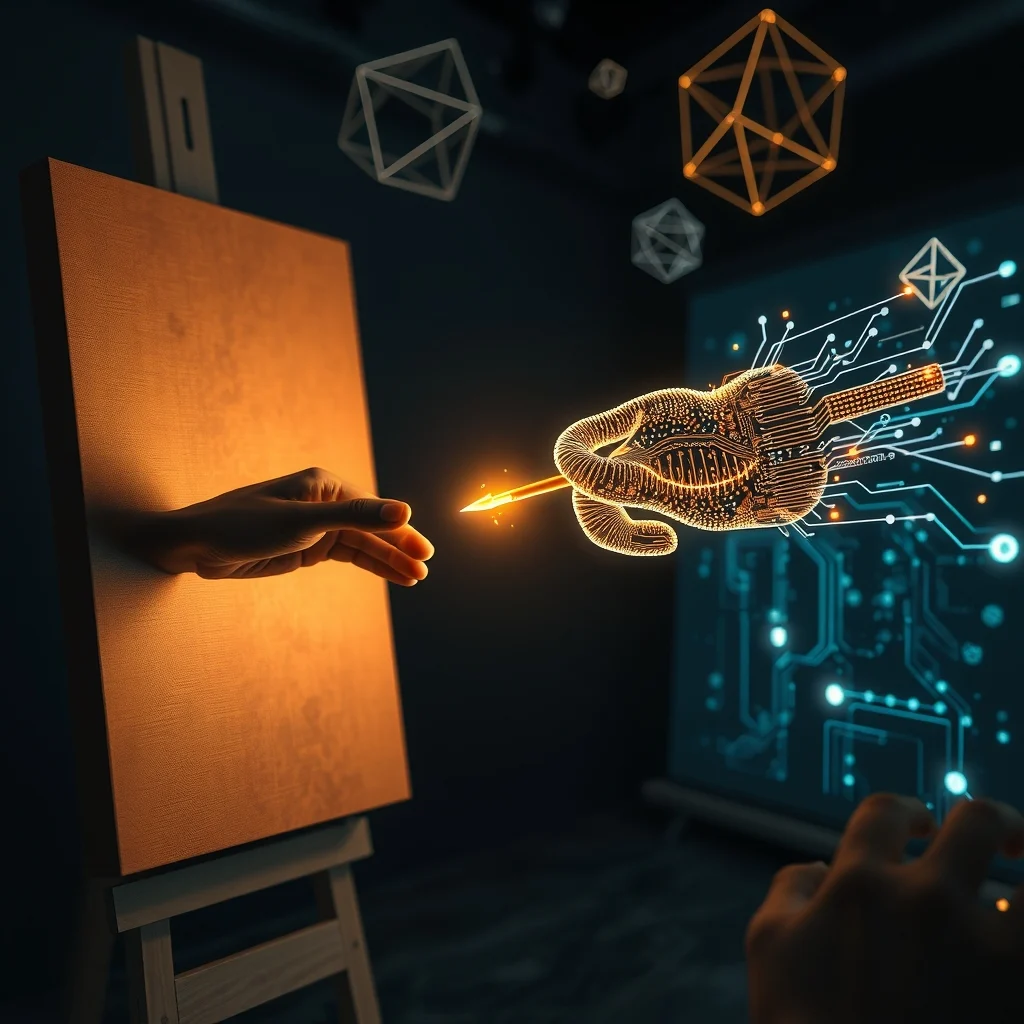

The digital landscape is undergoing a profound transformation driven by artificial intelligence. At the forefront of this revolution is AI-generated art, a phenomenon that blends creativity with advanced algorithms. This shift has sparked intense debate across the globe regarding ownership, authorship, and the very definition of creativity. As tools become more accessible, the implications for artists, legal systems, and society at large are becoming increasingly complex.
Understanding the nuances of this technology is essential for anyone involved in digital content creation. The rapid evolution of generative models has outpaced the development of regulatory frameworks. This article explores the critical legal and ethical dimensions surrounding AI art, providing a comprehensive analysis for creators and consumers alike. We will delve into copyright laws, ethical dilemmas, and practical guidelines for navigating this new frontier.
🌍 Overview of the AI Art Revolution
AI-generated art refers to visual imagery created with the assistance of artificial intelligence algorithms. These systems, often based on deep learning and neural networks, can produce images, illustrations, and designs from text prompts. The technology has matured rapidly, moving from experimental prototypes to powerful tools used by professionals and hobbyists. The accessibility of these tools has democratized art creation, allowing individuals without traditional training to produce high-quality visuals.
However, this democratization comes with significant challenges. The core of the controversy lies in how these models are trained. They ingest vast datasets of existing images, often scraped from the internet without explicit consent from the original creators. This raises questions about intellectual property rights and the moral implications of using human work to train machines. The art community is divided, with some embracing the efficiency and new possibilities, while others view it as a threat to their livelihood.
🧠 Analysis of the Current Landscape
The current state of AI art is defined by a tension between innovation and regulation. Governments and legal bodies are struggling to adapt existing laws to this new technology. The rapid pace of development means that by the time a law is proposed, the technology may have already evolved further. This creates a regulatory lag that leaves many questions unanswered.
1) Technical Background: The underlying technology relies on diffusion models and Generative Adversarial Networks. These systems learn patterns from data to generate new content that mimics the training set.
2) User Search Intent: Users are seeking clarity on whether they can own the copyright to AI images or if they risk infringement.
3) Market Relevance: The art market is integrating AI tools, creating new revenue streams but also disrupting traditional pricing models.
4) Future Outlook: We anticipate stricter regulations and more robust licensing models as the technology stabilizes.
🛡️ Understanding Copyright and Ownership
Copyright law is the first major hurdle in the AI art landscape. In many jurisdictions, copyright protection is granted to works of human authorship. This fundamental principle is being tested by AI systems that operate without direct human input. If a prompt is entered into a model, does the user own the resulting image, or does the copyright belong to the model developer?
Current rulings suggest that purely AI-generated works may not qualify for copyright protection. This means they could fall into the public domain immediately. However, if a human makes significant creative contributions, such as detailed editing or composition, protection might still be viable. This gray area creates uncertainty for commercial users who rely on exclusive rights to their content.
⚖️ The Legal Framework
🔹 Jurisdictional Differences
Laws vary significantly by region. The United States Copyright Office has stated that it will not register works created solely by AI. Conversely, the European Union is working on the AI Act, which aims to classify and regulate different levels of risk associated with AI systems. This includes transparency requirements for content generated by AI.
Developers must navigate a patchwork of regulations. A tool legal in one country might be restricted in another due to data privacy concerns or intellectual property laws. Artists need to be aware of where their work is being used and the specific laws governing that region. Compliance is becoming a key part of the business model for AI companies.
🔹 Training Data and Infringement
The training data for these models is often a source of litigation. Artists have sued major AI companies, claiming that their work was used without permission to train the systems. This is similar to a collage artist using existing magazine clippings, but on a massive scale. The argument for transformative use is central to these cases.
Companies argue that their models do not store specific images but rather learn abstract concepts. However, plaintiffs argue that the models can reproduce styles and even specific elements of copyrighted works. The outcome of these cases will set precedents for the entire industry. Until settled, the risk of infringement remains a concern for users.
🎨 Key Points of Legal Standing
| Category | Status | Notes |
|---|---|---|
| US Copyright | Human Authorship Required | AI alone cannot be an author. |
| EU AI Act | Risk-Based Regulation | Transparency required for generated content. |
| Privacy Rights | Varies by Region | GDPR impacts data scraping in Europe. |
| Commercial Use | Check License | Terms vary by platform provider. |
The table above summarizes the current standing of AI art across different legal categories. It is crucial for creators to understand that copyright is not automatic. While the US requires human authorship, other regions may have different standards. Commercial use requires careful review of the platform’s license agreement. Failure to comply can lead to legal disputes and financial penalties.
🆚 Distinguishing Factors from Traditional Art
AI art differs fundamentally from traditional creation methods. In traditional art, the process is linear and physical. The artist makes every mark. In AI art, the process is collaborative with a machine. The prompt is the seed, but the algorithm grows the tree. This distinction challenges the notion of skill and effort in art.
Furthermore, the reproducibility of AI art is nearly infinite. A single model can generate millions of variations instantly. This scalability is a double-edged sword. It allows for rapid prototyping but also contributes to the saturation of the market. The uniqueness of a single piece is diminished when the same style can be generated endlessly by anyone with access to the tool.
📊 Pros and Cons of AI Art
✅ Advantages
The benefits of AI art are significant for certain sectors. It lowers the barrier to entry for visual creation. Small businesses can generate marketing materials without hiring a designer. It also serves as a powerful brainstorming tool, allowing artists to visualize concepts quickly. This efficiency can accelerate the creative process and reduce costs.
✅ Accessibility: Anyone can create visuals regardless of skill level.
✅ Efficiency: Rapid generation of ideas and drafts.
✅ Cost Reduction: Reduces the need for expensive software or staff.
❌ Disadvantages
Despite the benefits, there are serious downsides. The primary concern is the displacement of human artists. If AI can do the work faster and cheaper, human artists may lose income. There is also the issue of homogenization, where art begins to look similar because it is all based on the same training data.
❌ Job Displacement: Risk to traditional illustrators and designers.
❌ Quality Variance: AI can produce inconsistent or nonsensical results.
❌ Ethical Concerns: Lack of consent from original data sources.
🔍 Practical Guide for Creators
🧩 Ethical Workflow Setup
To use AI art responsibly, creators should adopt a transparent workflow. This involves disclosing when AI is used in the final product. It also means respecting the rights of other artists. Avoid prompting the AI to mimic specific living artists unless you have permission.
1) Disclosure: Label your content as AI-generated if required by the platform.
2) Modification: Add significant human editing to the output to increase your creative claim.
3) Licensing: Ensure you have the right to use the generated images commercially.
🛡️ Common Errors and Mitigation
Many users make the mistake of assuming ownership of the raw output. This can lead to legal trouble if the model was trained on copyrighted material. Another common error is neglecting to check for plagiarism. AI can inadvertently replicate existing images.
⚠️ Check for Similarity: Use reverse image search to ensure the output is not a direct copy of existing work.
⚠️ Review Terms: Read the fine print of the AI tool regarding data retention.
⚠️ Ethical Sourcing: Avoid datasets that violate privacy or copyright.
📈 Industry Impact and Future Trends
🎮 Real Performance Experience
The impact on the creative industry is already visible. Advertising agencies are using AI for concept art. Game developers are using it for texture generation. The speed of production has increased, but the demand for unique human art remains high for high-end projects. The industry is shifting towards a hybrid model where AI handles the heavy lifting and humans handle the curation.
🌍 Global User Ratings
1) Average Rating: Users rate AI tools highly for utility but low for ethical comfort.
2) Positive Feedback: Praise focuses on speed and ease of use.
3) Negative Feedback: Complaints center on copyright and job security.
4) Trend Analysis: Trust in AI art is growing but remains conditional on regulation.
🔰 Security and Risk Management
🔒 Security Level
Security in AI art is not just about data privacy but also about misinformation. AI-generated images can be used for deepfakes or disinformation campaigns. This poses a risk to public trust. Ensuring the authenticity of digital content is becoming a priority for platforms and governments.
🛑 Potential Risks
Users must be aware of the data risks associated with these tools. Uploading proprietary images to public AI models can expose them to being used in future training sets. This is a significant risk for companies with intellectual property.
⚠️ Data Leakage: Do not upload sensitive or confidential images to public models.
⚠️ Malicious Prompts: Be aware of prompts that can generate harmful content.
⚠️ Model Bias: Understand that the model may reflect biases in its training data.
🆚 Comparison of Platforms
🥇 Best Available Alternatives
| Platform | Focus | Best For |
|---|---|---|
| Midjourney | Artistic Quality | Concept art and stylized images. |
| DALL-E 3 | Text Accuracy | Text-in-image and detailed prompts. |
| Stable Diffusion | Control | Local installation and customization. |
Each platform has its strengths and weaknesses. Midjourney is known for aesthetic quality but lacks text control. DALL-E 3 is excellent at following instructions but has stricter content filters. Stable Diffusion offers the most control but requires technical knowledge. Choosing the right tool depends on your specific needs and technical comfort level.
💡 Tips for Compliance
🎯 Best Settings for Maximum Performance
Optimizing your AI usage involves more than just prompts. It involves understanding the settings that affect output and compliance. Using safe search modes can prevent the generation of prohibited content. Adjusting the guidance scale can help balance creativity with adherence to your prompt.
✅ Safe Search: Enable filters to prevent policy violations.
✅ Guidance Scale: Adjust to control how strictly the AI follows your prompt.
✅ Seed Control: Use seeds to replicate styles you like consistently.
📌 Advanced Tricks Few Know
Experienced users know that post-processing is key. Taking the AI output and editing it in software like Photoshop adds a layer of human input that strengthens copyright claims. It also allows you to fix errors that the AI cannot resolve. This hybrid approach is becoming the industry standard for professional work.
Advanced techniques include using inpainting to fix specific areas without regenerating the whole image. This saves time and ensures consistency. Another trick is using negative prompts to exclude unwanted elements. These strategies help refine the output to meet professional standards.
🏁 Final Verdict
The rise of AI-generated art is irreversible. It represents a new chapter in human creativity. However, it brings challenges that require careful navigation. Legal frameworks are catching up, but ethical standards must be set by the community. Creators who adapt responsibly will thrive in this new environment.
We recommend a cautious approach. Use AI as a tool, not a replacement for human creativity. Respect the rights of others and stay informed about legal changes. The future of art depends on how we balance innovation with integrity.
❓ Frequently Asked Questions
1) Can I copyright an AI-generated image?
Currently, no. Most copyright offices require human authorship. You may need to add significant human modification to claim copyright.
2) Is it legal to use AI art for commercial projects?
It depends on the terms of the AI tool. Some allow commercial use, while others restrict it. Always check the license agreement.
3) How is AI art different from traditional art?
AI art is generated by algorithms based on data, whereas traditional art is created manually by the artist. The process and ownership differ significantly.
4) Do AI models steal artists’ work?
This is a subject of ongoing litigation. AI models train on public data, which artists argue includes their work without consent.
5) Can AI art be used in advertising?
Yes, but you must ensure you have the rights to use the image. Some platforms prohibit commercial use for free tiers.
6) What are the ethical risks of AI art?
Risks include bias, deepfakes, and the potential devaluation of human artistic labor. Transparency is key to mitigating these risks.
7) Which AI tool is best for beginners?
DALL-E 3 is user-friendly and integrates well with chat interfaces. It is a good starting point for non-technical users.
8) Will AI replace human artists?
It is unlikely to replace them entirely. Instead, it will likely change the workflow, requiring artists to learn new digital skills.
9) How can I protect my style from AI mimicry?
There is no perfect protection. However, registering your work and using watermarks can help deter unauthorized use.
10) What is the future of AI art regulation?
We expect stricter laws regarding data privacy and disclosure. The EU AI Act is a leading example of this trend.