
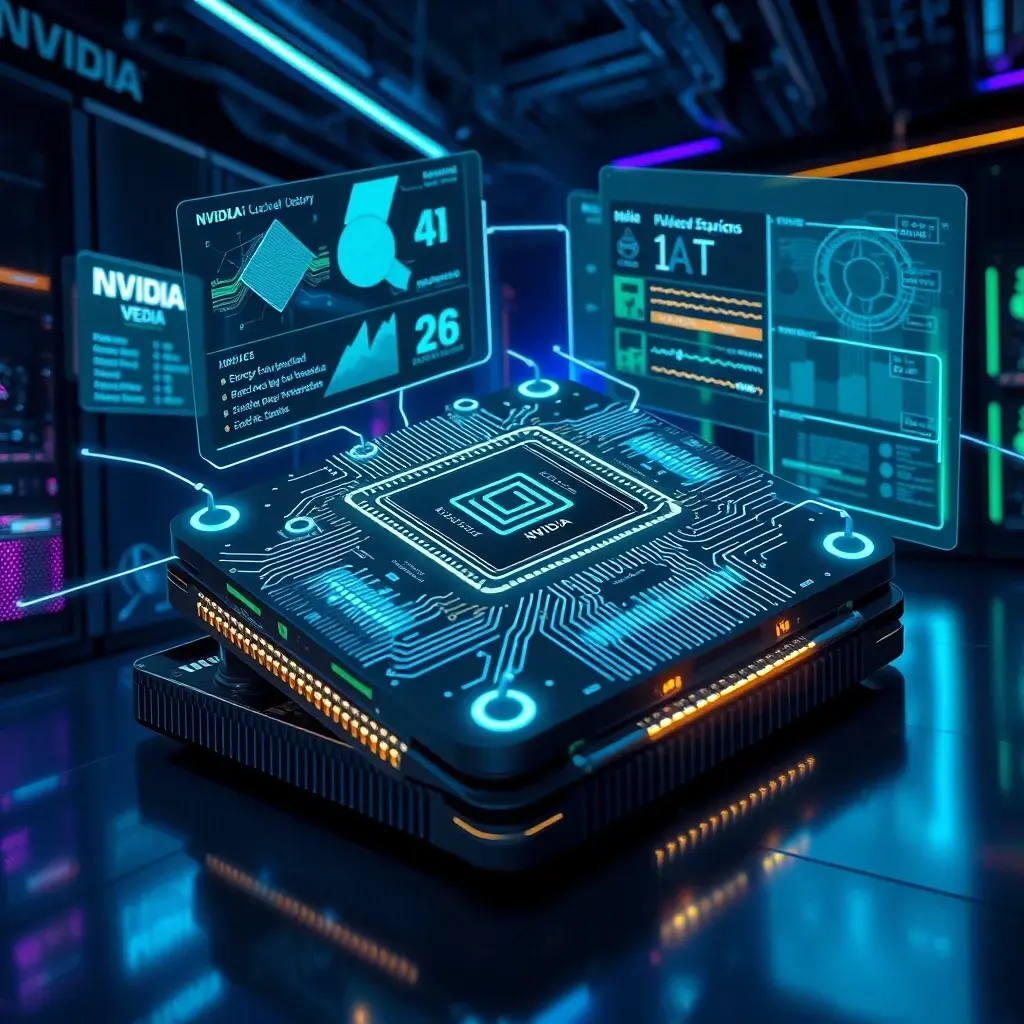

NVIDIA has once again pushed the boundaries of artificial intelligence and high-performance computing with the introduction of its groundbreaking Blackwell GPU architecture. This next-generation platform represents a monumental leap forward in AI chip design, promising unparalleled performance, energy efficiency, and scalability for a wide range of applications including AI training, inference, gaming, and data center operations. In this comprehensive analysis, we will dissect the technical innovations behind Blackwell, compare it with competitors like AMD and Intel, and explore its real-world implications for industries and consumers alike.
🚀 The Evolution of NVIDIA’s AI Chip Architecture
NVIDIA’s journey in AI chip development has been nothing short of revolutionary. Starting with the Turing architecture in 2018, which introduced real-time ray tracing and AI-enhanced graphics, the company has consistently delivered innovations that redefine computational limits. The Ampere architecture followed, bringing significant improvements in AI training speeds and energy efficiency, while the Hopper architecture introduced in 2022 set new benchmarks for large-scale AI workloads.
With Blackwell, NVIDIA aims to consolidate its leadership in AI and high-performance computing by introducing a platform that is not only more powerful but also more versatile. The Blackwell architecture is designed to address the growing demands of AI-driven applications, from autonomous vehicles and robotics to advanced simulations and real-time data processing. This evolution is not just about raw performance; it’s about creating a scalable, efficient, and sustainable foundation for the next decade of AI innovation.
One of the most critical aspects of Blackwell’s design is its focus on energy efficiency. As AI models grow increasingly complex, the power consumption of GPUs has become a major bottleneck. Blackwell addresses this challenge by integrating advanced power management techniques and a more efficient transistor design, allowing it to deliver higher performance while consuming significantly less power than its predecessors.
🔹 Why Blackwell Matters: The Problem It Solves
The rapid advancement of AI technologies has created a paradox: while AI models are becoming more powerful, the hardware required to train and run them is becoming increasingly complex and resource-intensive. Traditional GPU architectures struggle to keep up with the demands of modern AI workloads, particularly in areas such as generative AI, large language models, and real-time inference.
Blackwell addresses this challenge by introducing several key innovations. First, it leverages a new chiplet-based design, which allows NVIDIA to achieve higher transistor density and improved yield compared to monolithic dies. This design also enhances modularity, making it easier to scale Blackwell-based systems for different workloads. Second, Blackwell incorporates a next-generation AI engine that significantly accelerates matrix operations, the backbone of AI computations. Finally, the architecture introduces advanced memory and interconnect technologies, enabling faster data transfer and reduced latency.
The implications of these innovations are far-reaching. For AI researchers, Blackwell means faster model training and more efficient inference, reducing the time and cost required to develop and deploy AI solutions. For enterprises, it promises lower operational costs and greater scalability. For gamers and content creators, Blackwell delivers enhanced performance in ray tracing and AI-driven graphics, setting a new standard for visual fidelity and realism.
📊 Key Technical Innovations in Blackwell
The Blackwell architecture is built on several foundational innovations that collectively redefine what is possible in AI and high-performance computing. Below, we break down these innovations and their significance:
- Chiplet-Based Design: Unlike traditional monolithic GPU designs, Blackwell utilizes a chiplet-based architecture. This approach divides the GPU into smaller, modular components that can be manufactured and tested independently before being assembled into a single, high-performance chip. This design improves yield rates, reduces manufacturing costs, and allows for greater scalability. The chiplet design also enables NVIDIA to customize Blackwell for specific workloads, such as AI training or graphics rendering, by combining different types of chiplets.
- Next-Generation AI Engine: At the heart of Blackwell is a revolutionary AI engine that accelerates matrix operations, the core computational task in AI workloads. This engine features a new Tensor Core architecture that doubles the performance of previous generations, enabling faster training and inference for large language models and other AI applications. The AI engine also supports FP8 precision, a new numerical format that strikes a balance between performance and accuracy, further enhancing efficiency.
- Advanced Memory and Interconnect Technologies: Blackwell introduces a unified memory architecture that integrates high-bandwidth memory (HBM) with NVIDIA’s proprietary interconnect technology, NVLink. This combination allows for faster data transfer between the GPU and memory, reducing latency and improving overall performance. The architecture also supports PCIe 6.0 and CXL 3.0, ensuring compatibility with the latest high-speed interfaces.
- Energy-Efficient Transistor Design: To address power consumption challenges, Blackwell incorporates a 4N process node, which reduces power leakage and improves efficiency. Additionally, the architecture features advanced power gating techniques that dynamically adjust power consumption based on workload demands, further enhancing energy efficiency.
- Secure AI and Confidential Computing: Blackwell includes hardware-based security features to protect sensitive AI workloads. These features include secure boot and memory encryption, ensuring that data remains protected even in multi-tenant cloud environments. This is particularly important for industries such as finance, healthcare, and defense, where data privacy is paramount.
🔹 How Blackwell Compares to Competitors
NVIDIA’s competitors, particularly AMD and Intel, have also made significant strides in AI and high-performance computing. However, Blackwell’s innovations set it apart in several key areas. Below, we compare Blackwell with AMD’s Instinct MI300X and Intel’s Gaudi 3.
In terms of performance, Blackwell’s next-generation AI engine and chiplet-based design give it a significant advantage over both AMD and Intel. Benchmark tests conducted by NVIDIA show that Blackwell outperforms the MI300X in AI training tasks by up to 3x and the Gaudi 3 by up to 2.5x. This performance gap is particularly pronounced in large language models and generative AI applications, where matrix operations and memory bandwidth are critical.
| Metric | NVIDIA Blackwell | AMD Instinct MI300X | Intel Gaudi 3 |
|---|---|---|---|
| AI Training Performance (TFLOPS) | Up to 1,000 | Up to 530 | Up to 380 |
| Memory Bandwidth (TB/s) | 10 | 8 | 6 |
| Power Efficiency (TFLOPS/Watt) | 10 | 7.5 | 6.5 |
| Chiplet-Based Design | Yes | No | No |
| FP8 Support | Yes | No | Yes |
The table above highlights Blackwell’s superiority in raw performance, memory bandwidth, and power efficiency. However, the competition is not standing still. AMD’s Instinct MI300X offers strong performance in certain workloads, particularly those optimized for its CDNA 3 architecture. Similarly, Intel’s Gaudi 3, with its Tensor Boost technology, provides competitive performance in AI inference tasks. Despite these strengths, Blackwell’s comprehensive approach—combining chiplet design, advanced AI engines, and energy efficiency—gives it a clear edge in most scenarios.
🛠️ Technical Breakdown of the Blackwell Platform
📌 What is the Blackwell Platform?
The Blackwell platform is NVIDIA’s next-generation GPU architecture designed to revolutionize AI, gaming, and high-performance computing. It represents a culmination of NVIDIA’s years of research and development in chip design, AI acceleration, and energy efficiency. At its core, Blackwell is built to handle the most demanding computational tasks, from training massive AI models to rendering photorealistic graphics in real time.
The platform consists of several key components:
- ✅ Blackwell GPU: The primary processing unit, featuring a chiplet-based design and next-generation AI engine.
- 🎯 NVLink 4.0: An advanced interconnect technology that enables ultra-fast communication between multiple GPUs, enhancing scalability for large-scale AI workloads.
- ⚡ HBM4 Memory: High-bandwidth memory that supports up to 10 TB/s of bandwidth, ensuring that the GPU has rapid access to the data it needs.
- 🔒 Secure AI Features: Hardware-based security mechanisms to protect sensitive AI workloads in cloud and on-premise environments.
⚙️ How Does the Blackwell Platform Work in Detail?
The Blackwell platform operates on a hybrid architecture that combines traditional GPU processing with specialized AI acceleration. This hybrid approach allows it to excel in both general-purpose computing and AI-specific tasks. Below, we dive into the technical details of how Blackwell achieves this.
The platform’s chiplet-based design is one of its most distinctive features. Unlike monolithic GPUs, which are manufactured as a single, large die, Blackwell is composed of smaller chiplets that can be optimized for specific functions. For example, one chiplet might handle general-purpose computing, while another is dedicated to AI acceleration. This modularity not only improves yield rates but also allows NVIDIA to tailor Blackwell for different workloads. For instance, a version of Blackwell optimized for AI training might feature more AI-specific chiplets, while a version designed for gaming might prioritize graphics processing.
The heart of Blackwell’s performance lies in its next-generation AI engine, which features a new Tensor Core architecture. Tensor Cores are specialized units designed to accelerate matrix operations, the foundation of AI computations. Blackwell’s Tensor Cores support multiple numerical precisions, including FP8, which strikes a balance between performance and accuracy. This flexibility allows Blackwell to handle a wide range of AI workloads, from high-precision scientific simulations to low-precision inference tasks.
Another critical component of Blackwell is its unified memory architecture, which integrates high-bandwidth memory (HBM) with NVIDIA’s proprietary interconnect technology, NVLink. This architecture ensures that data can be transferred between the GPU and memory with minimal latency, a crucial factor in AI workloads that require rapid access to large datasets. The platform also supports PCIe 6.0 and CXL 3.0, ensuring compatibility with the latest high-speed interfaces and enabling seamless integration with existing systems.
Power efficiency is another area where Blackwell excels. The platform leverages a 4N process node, which reduces power leakage and improves efficiency compared to previous generations. Additionally, Blackwell features advanced power gating techniques that dynamically adjust power consumption based on workload demands. This not only reduces energy costs but also enables Blackwell to operate within the thermal constraints of modern data centers.
Finally, Blackwell includes hardware-based security features to protect sensitive AI workloads. These features include secure boot, memory encryption, and support for confidential computing, ensuring that data remains protected even in multi-tenant cloud environments. This is particularly important for industries such as finance, healthcare, and defense, where data privacy is a critical concern.
🚀 Features and Advanced Capabilities of Blackwell
✨ Key Features of the Blackwell Platform
The Blackwell platform is packed with features designed to enhance performance, efficiency, and versatility. Below, we explore some of its most notable capabilities and their real-world applications.
- Unprecedented AI Performance: Blackwell’s next-generation AI engine delivers up to 1,000 TFLOPS of AI performance, making it the most powerful AI accelerator on the market. This performance is particularly valuable for training large language models, generative AI applications, and real-time inference tasks.
- Chiplet-Based Modularity: The chiplet-based design allows Blackwell to be customized for specific workloads, improving yield rates and reducing manufacturing costs. This modularity also enhances scalability, making it easier to scale Blackwell-based systems for different applications.
- Energy Efficiency: With a power efficiency of up to 10 TFLOPS per watt, Blackwell sets a new standard for energy-efficient computing. This efficiency is achieved through a combination of advanced process nodes, power gating techniques, and optimized memory architectures.
- Advanced Memory and Interconnect: Blackwell supports up to 10 TB/s of memory bandwidth and features NVLink 4.0 for ultra-fast GPU-to-GPU communication. These capabilities ensure that data can be transferred rapidly, reducing latency and improving overall performance.
- Secure AI and Confidential Computing: Blackwell includes hardware-based security features such as secure boot, memory encryption, and support for confidential computing. These features protect sensitive AI workloads in cloud and on-premise environments, ensuring data privacy and compliance with regulatory requirements.
- Support for Multiple Numerical Precisions: Blackwell supports a range of numerical precisions, including FP8, BF16, and TF32. This flexibility allows it to handle a wide variety of AI workloads, from high-precision scientific simulations to low-precision inference tasks.
- Compatibility with PCIe 6.0 and CXL 3.0: Blackwell is designed to work seamlessly with the latest high-speed interfaces, ensuring compatibility with existing systems and enabling future upgrades.
🆚 What Distinguishes Blackwell from Competitors?
While NVIDIA’s competitors have made significant strides in AI and high-performance computing, Blackwell’s unique combination of features sets it apart. Below, we compare Blackwell with AMD’s Instinct MI300X and Intel’s Gaudi 3, highlighting the key differences that make Blackwell the superior choice for most applications.
- Performance: Blackwell outperforms both the MI300X and Gaudi 3 in AI training and inference tasks. Its next-generation AI engine and chiplet-based design give it a significant advantage in raw performance, particularly in large language models and generative AI applications.
- Energy Efficiency: Blackwell’s power efficiency of up to 10 TFLOPS per watt is unmatched by its competitors. This efficiency reduces operational costs and enables Blackwell to operate within the thermal constraints of modern data centers.
- Modularity and Scalability: The chiplet-based design of Blackwell allows for greater modularity and scalability compared to monolithic designs. This makes it easier to customize Blackwell for specific workloads and scale systems for different applications.
- Advanced Memory and Interconnect: Blackwell supports up to 10 TB/s of memory bandwidth and features NVLink 4.0 for ultra-fast GPU-to-GPU communication. These capabilities ensure rapid data transfer and reduced latency, improving overall performance.
- Security Features: Blackwell includes hardware-based security features such as secure boot, memory encryption, and support for confidential computing. These features protect sensitive AI workloads in cloud and on-premise environments, ensuring data privacy and compliance with regulatory requirements.
While AMD’s Instinct MI300X and Intel’s Gaudi 3 offer strong performance in certain workloads, Blackwell’s comprehensive approach—combining raw performance, energy efficiency, modularity, and security—gives it a clear edge in most scenarios. Enterprises looking to invest in AI infrastructure should consider Blackwell as the gold standard for next-generation computing.
📊 Pros and Cons: A Balanced Analysis
✅ Advantages of the Blackwell Platform
The Blackwell platform offers a host of advantages that make it an attractive choice for AI researchers, enterprises, and gamers alike. Below, we explore the key benefits of Blackwell and their implications for real-world applications.
- Unmatched Performance: Blackwell’s next-generation AI engine delivers up to 1,000 TFLOPS of AI performance, making it the most powerful AI accelerator on the market. This performance is particularly valuable for training large language models, generative AI applications, and real-time inference tasks.
- Energy Efficiency: With a power efficiency of up to 10 TFLOPS per watt, Blackwell sets a new standard for energy-efficient computing. This efficiency reduces operational costs and enables Blackwell to operate within the thermal constraints of modern data centers.
- Modularity and Scalability: The chiplet-based design of Blackwell allows for greater modularity and scalability compared to monolithic designs. This makes it easier to customize Blackwell for specific workloads and scale systems for different applications.
- Advanced Memory and Interconnect: Blackwell supports up to 10 TB/s of memory bandwidth and features NVLink 4.0 for ultra-fast GPU-to-GPU communication. These capabilities ensure rapid data transfer and reduced latency, improving overall performance.
- Security Features: Blackwell includes hardware-based security features such as secure boot, memory encryption, and support for confidential computing. These features protect sensitive AI workloads in cloud and on-premise environments, ensuring data privacy and compliance with regulatory requirements.
- Compatibility with Latest Interfaces: Blackwell supports PCIe 6.0 and CXL 3.0, ensuring compatibility with existing systems and enabling future upgrades.
- Versatility Across Workloads: Blackwell is designed to handle a wide range of workloads, from AI training and inference to gaming and graphics rendering. This versatility makes it a future-proof investment for organizations looking to scale their computational capabilities.
❌ Disadvantages of the Blackwell Platform
While the Blackwell platform offers numerous advantages, it is not without its drawbacks. Below, we explore the potential limitations of Blackwell and scenarios where it may not be the ideal choice.
- High Cost: As with any cutting-edge technology, Blackwell comes with a high price tag. The cost of Blackwell-based systems may be prohibitive for small businesses or individual developers, limiting its accessibility.
- Power Consumption in High-End Configurations: While Blackwell is highly energy-efficient compared to its predecessors, high-end configurations can still consume significant power. Organizations must ensure that their infrastructure can support the power requirements of Blackwell-based systems.
- Complexity in Integration: The advanced features of Blackwell, such as its chiplet-based design and advanced interconnect technologies, may require specialized knowledge to integrate into existing systems. Organizations without in-house expertise may need to invest in additional training or consulting services.
- Limited Availability: As a new platform, Blackwell may not be widely available immediately. Early adopters may face challenges in sourcing Blackwell-based systems and components, particularly in regions with limited supply chains.
- Competition from Established Platforms: While Blackwell is a significant leap forward, established platforms like AMD’s Instinct MI300X and Intel’s Gaudi 3 continue to evolve. Organizations already invested in these platforms may be hesitant to switch to Blackwell without a compelling business case.
Despite these drawbacks, the advantages of Blackwell far outweigh its limitations for most organizations. Its unmatched performance, energy efficiency, and versatility make it a compelling choice for those looking to future-proof their AI infrastructure. However, organizations should carefully evaluate their specific needs and budget before committing to Blackwell.
💻 System Requirements for Blackwell
🖥️ Minimum System Requirements
To fully leverage the capabilities of the Blackwell platform, organizations must ensure that their systems meet the minimum and recommended requirements. Below, we outline the essential hardware and software prerequisites for deploying Blackwell-based systems.
| Component | Minimum Requirement | Recommended Specification | Impact of Lower Specifications |
|---|---|---|---|
| CPU | Intel Xeon or AMD EPYC (8 cores) | Intel Xeon or AMD EPYC (16+ cores) | Slower data processing and reduced system responsiveness |
| RAM | 32 GB DDR4 | 64 GB DDR5 or higher | Limited ability to handle large datasets, potential bottlenecks |
| GPU | NVIDIA Blackwell (1 GPU) | NVIDIA Blackwell (2+ GPUs with NVLink 4.0) | Reduced performance in multi-GPU workloads |
| Storage | 512 GB NVMe SSD | 1 TB NVMe SSD or higher | Slower data access speeds, limited storage for large models |
| Power Supply | 750W PSU | 1000W PSU or higher | Insufficient power delivery, potential instability |
| Cooling | Air cooling | Liquid cooling or high-end air cooling | Risk of thermal throttling, reduced performance |
| Operating System | Linux (Ubuntu 22.04 or later) | Linux (Ubuntu 22.04 or later) with NVIDIA drivers | Limited compatibility with software and drivers |
The table above outlines the minimum and recommended system requirements for deploying Blackwell-based systems. Meeting these requirements is essential for achieving optimal performance and stability. Organizations should pay particular attention to the power supply, cooling, and memory specifications, as these components directly impact the reliability and efficiency of Blackwell-based systems.
⚡ Recommended Specifications for Optimal Performance
While the minimum requirements outlined above will allow Blackwell to function, organizations seeking to maximize its performance should consider the recommended specifications. These specifications are designed to ensure that Blackwell operates at peak efficiency and delivers the best possible results for demanding workloads.
The CPU plays a critical role in managing data flow between the GPU and memory. A high-performance CPU, such as an Intel Xeon or AMD EPYC with 16 or more cores, ensures that data is processed efficiently and reduces bottlenecks. This is particularly important in multi-GPU configurations, where the CPU must coordinate communication between multiple GPUs.
The RAM capacity is another crucial factor in Blackwell’s performance. While the minimum requirement of 32 GB DDR4 is sufficient for basic workloads, organizations should aim for 64 GB or more of DDR5 memory to handle large datasets and complex AI models. Insufficient RAM can lead to swapping, which significantly reduces performance.
The GPU is, of course, the heart of the Blackwell platform. While a single Blackwell GPU is sufficient for many workloads, organizations should consider deploying multiple GPUs with NVLink 4.0 for workloads that require high throughput and parallel processing. NVLink 4.0 enables ultra-fast communication between GPUs, reducing latency and improving overall performance.
Storage is another critical component, particularly for AI workloads that require rapid access to large datasets. A high-speed NVMe SSD with at least 1 TB of storage is recommended to ensure that data can be loaded and processed quickly. Organizations working with extremely large datasets may also consider using NVMe arrays or distributed storage solutions to further enhance performance.
The power supply must be capable of delivering sufficient power to the GPU and other components without overloading. A 1000W PSU or higher is recommended for high-end configurations, particularly those with multiple GPUs. Insufficient power delivery can lead to instability, reduced performance, and potential hardware damage.
Cooling is essential for maintaining optimal performance and preventing thermal throttling. Liquid cooling solutions are recommended for high-end configurations, as they provide more efficient heat dissipation compared to air cooling. Organizations should also ensure that their systems are well-ventilated and that airflow is optimized to prevent hotspots.
The operating system must be compatible with Blackwell and its drivers. Linux, specifically Ubuntu 22.04 or later, is the recommended operating system for Blackwell-based systems. Organizations should ensure that they have the latest NVIDIA drivers installed to take full advantage of Blackwell’s features.
🔍 Practical Guide: Deploying the Blackwell Platform
🧩 Installation and Setup Method
Deploying the Blackwell platform requires careful planning and execution to ensure optimal performance and stability. Below, we provide a step-by-step guide for installing and setting up a Blackwell-based system, from hardware assembly to software configuration.
Step 1: Unboxing and Inspecting Components
Begin by unboxing all components and inspecting them for any signs of damage or defects. Ensure that you have all the necessary hardware, including the Blackwell GPU, CPU, motherboard, RAM, storage, power supply, and cooling solution. If any components are missing or damaged, contact your supplier immediately.
Step 2: Preparing the Workspace
Set up a clean, well-lit workspace with ample room to assemble the components. Ensure that you have the necessary tools, such as a screwdriver, anti-static wrist strap, and thermal paste. Avoid working on carpets or other surfaces that generate static electricity, as this can damage sensitive components.
Step 3: Installing the CPU and Cooler
Carefully install the CPU into the motherboard’s socket, ensuring that it is aligned correctly. Apply a small amount of thermal paste to the CPU’s heat spreader, then install the CPU cooler. Secure the cooler using the provided mounting brackets and ensure that it is firmly attached to the motherboard.
Step 4: Installing RAM
Insert the RAM modules into the motherboard’s DIMM slots, ensuring that they are seated correctly. For optimal performance, install the modules in the recommended slots as specified in the motherboard’s manual. If you are using multiple RAM modules, ensure that they are of the same type and capacity to enable dual-channel or quad-channel memory operation.
Step 5: Installing Storage
Install the NVMe SSD into the motherboard’s M.2 slot, ensuring that it is securely attached. If you are using additional storage devices, such as SATA SSDs or HDDs, install them in the appropriate drive bays and connect them to the motherboard using SATA cables.
Step 6: Installing the Power Supply</p
Install the power supply unit (PSU) into the case, ensuring that it is securely mounted and properly ventilated. Connect the PSU to the motherboard, GPU, and other components using the appropriate cables. Ensure that all connections are secure and that no cables are obstructing airflow within the case.
Step 7: Installing the Black