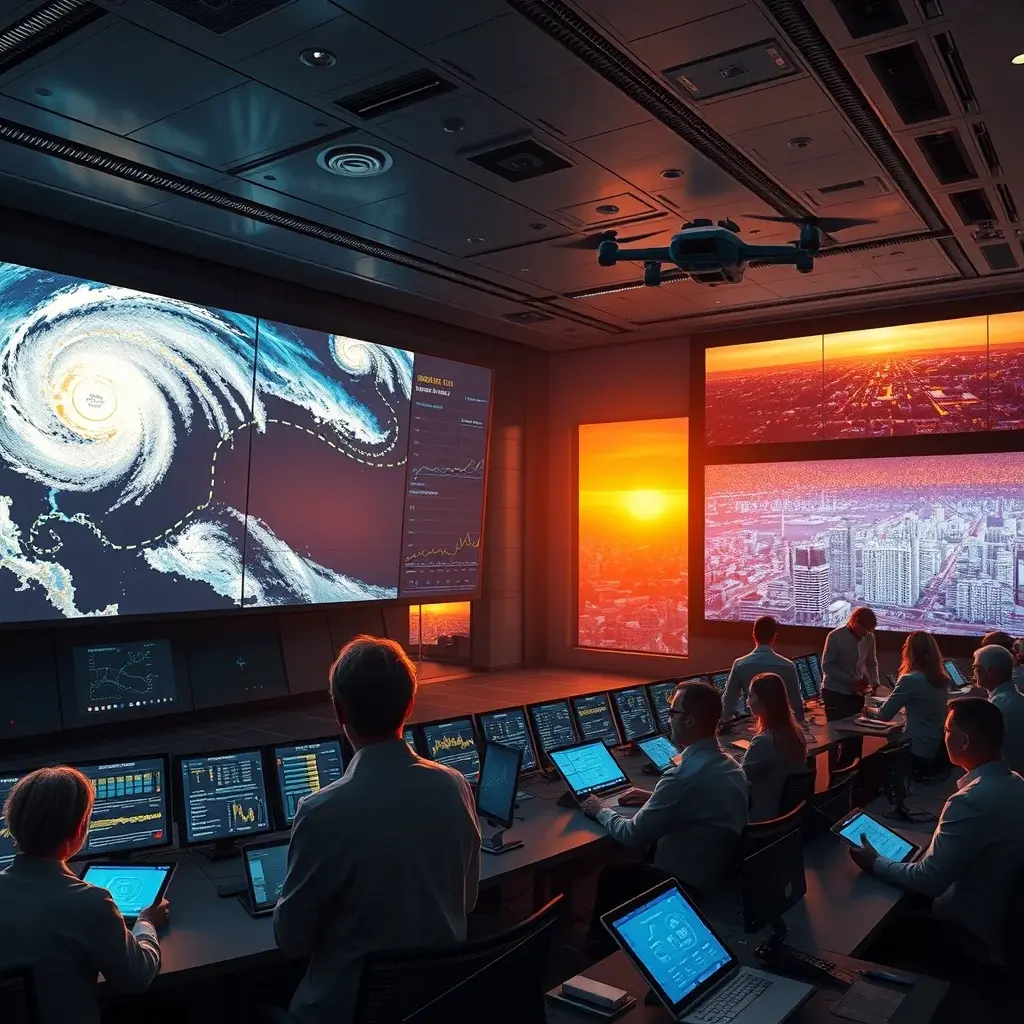

The integration of artificial intelligence (AI) into disaster prediction and emergency response represents one of the most transformative advancements in modern technology. As climate change intensifies the frequency and severity of natural disasters, the need for precise and timely interventions has never been greater. AI, particularly through machine learning algorithms, is revolutionizing how we anticipate, prepare for, and respond to catastrophes such as earthquakes, hurricanes, and wildfires. By analyzing vast datasets, identifying patterns, and simulating scenarios, AI empowers governments, organizations, and communities to mitigate risks and save lives.
🌍 Introduction: The Critical Need for AI in Disaster Management
Natural disasters claim thousands of lives annually and cause billions in economic damage. Traditional methods of prediction and response, while effective to some extent, often struggle with the unpredictability and scale of modern catastrophes. This is where AI steps in, offering unparalleled capabilities in data processing and predictive modeling. The urgency of climate-related disasters has pushed researchers and technologists to leverage AI for creating systems that can forecast events with higher accuracy and shorter lead times than ever before.
AI-driven disaster management is not just about predicting disasters; it’s about optimizing every phase of the disaster lifecycle. From early warnings to coordinated evacuations and post-disaster recovery, AI enables a proactive rather than reactive approach. This shift is crucial because every minute counts in disaster scenarios, and delays in response can lead to catastrophic outcomes. For instance, AI can analyze seismic activity in real-time to predict earthquakes, giving communities precious seconds or minutes to take shelter. Similarly, AI models can track atmospheric conditions to forecast hurricanes with unprecedented precision, allowing authorities to issue timely evacuations.
The integration of AI into disaster management is also democratizing access to critical information. Platforms such as IBM’s Weather Company provide hyperlocal weather forecasts that help individuals and businesses make informed decisions. These tools are not just for governments; they empower everyday people to take proactive measures, whether it’s securing property before a storm or choosing safer routes during an evacuation.
🌪️ AI-Powered Disaster Prediction: Turning Data into Early Warnings
🔮 The Science Behind AI Disaster Prediction
At the heart of AI-driven disaster prediction lies machine learning, a subset of AI that excels at identifying patterns in large datasets. Unlike traditional statistical models, machine learning algorithms can process and analyze diverse data sources simultaneously, including satellite imagery, weather stations, seismic sensors, and even social media posts. This multi-source data fusion allows AI models to detect anomalies and predict disasters with higher accuracy.
For example, AI models designed to predict wildfires can analyze historical data on temperature, humidity, wind patterns, and vegetation dryness. By training on these variables, the model can identify areas at high risk of ignition. When combined with real-time data from drones and IoT sensors, these predictions become even more precise. Similarly, AI systems used for hurricane prediction ingest data from ocean buoys, satellite imagery, and atmospheric models to simulate storm paths and intensities.
One of the most compelling examples of AI in action is Google’s AI for Social Good initiative, which has developed models for flood prediction. These models use a combination of satellite data and machine learning to map flood risks in regions prone to monsoons or river overflows. By providing governments and NGOs with detailed risk maps, these tools enable targeted interventions, such as reinforcing levees or evacuating specific neighborhoods.
📊 Key Datasets and Technologies Driving AI Prediction
The accuracy of AI models depends heavily on the quality and diversity of the datasets they are trained on. Some of the most critical data sources include:
- ✅ Satellite imagery: High-resolution images from satellites like NASA’s Landsat and the European Space Agency’s Sentinel series provide real-time data on weather patterns, vegetation health, and land surface temperatures. These images are essential for tracking wildfires, droughts, and storms.
- ✅ IoT sensors: Internet of Things (IoT) devices, such as weather stations, seismic sensors, and water level monitors, feed real-time data into AI models. For instance, sensors placed in rivers can detect sudden rises in water levels, triggering flood alerts.
- ✅ Historical records: AI models rely on decades of historical data to identify patterns and anomalies. For example, earthquake prediction models analyze decades of seismic activity to detect precursors to major quakes.
- ✅ Social media and crowdsourcing: Platforms like Twitter and Facebook provide real-time, human-generated data that can complement traditional datasets. AI systems can analyze social media posts to detect early signs of disasters, such as reports of smoke or flooding.
Another groundbreaking technology is digital twins, which are virtual replicas of physical systems. In disaster management, digital twins can simulate entire cities or regions, allowing authorities to test evacuation routes, assess infrastructure vulnerabilities, and predict the impact of hypothetical disasters. For instance, the city of Rotterdam in the Netherlands uses digital twins to model flood scenarios and optimize its flood defense systems.
🌍 Real-World Applications of AI in Disaster Prediction
The practical applications of AI in disaster prediction are already saving lives and resources. One notable example is the Hurricane Prediction System developed by IBM’s Weather Company. This system uses AI to analyze atmospheric data and predict hurricane paths with greater accuracy than traditional models. During Hurricane Ian in 2022, the AI model provided more precise forecasts than the National Hurricane Center’s official predictions, enabling more targeted evacuations and resource allocation.
Similarly, AI is making strides in wildfire prediction. The FireSat system, developed by NASA and the U.S. Forest Service, uses satellite data and AI to detect wildfires within minutes of ignition. This early detection allows firefighters to respond quickly and contain fires before they spread uncontrollably. In California, where wildfires have become increasingly severe, AI-driven systems like FireGuard are being deployed to monitor high-risk areas and predict fire spread.
AI is also playing a crucial role in earthquake prediction. While predicting earthquakes with absolute certainty remains an unsolved challenge, AI models can identify patterns in seismic activity that precede major quakes. For example, researchers at Stanford University developed an AI model that analyzes data from seismic networks to detect foreshocks—small tremors that occur before a major earthquake. While these systems are not yet 100% accurate, they represent a significant step forward in early warning systems.
🛠️ How AI Enhances Emergency Response: From Alerts to Action
🚨 The Evolution of Emergency Response Systems
Emergency response has traditionally relied on manual processes, such as phone calls, radio broadcasts, and in-person coordination. While these methods are effective, they are often slow and prone to errors, especially in large-scale disasters. AI is transforming emergency response by automating key processes, optimizing resource allocation, and improving decision-making under pressure.
One of the most significant advancements is the use of AI-powered emergency dispatch systems. These systems use natural language processing (NLP) to analyze emergency calls and prioritize responses based on the severity of the situation. For example, an AI system can instantly categorize a call about a collapsed building as a high-priority event and dispatch the nearest rescue teams with the appropriate equipment.
AI is also enhancing evacuation planning. By analyzing real-time data on traffic patterns, road conditions, and population density, AI systems can dynamically adjust evacuation routes to avoid congestion and hazards. For instance, during the 2021 floods in Germany, AI-driven systems helped authorities identify the fastest and safest evacuation routes, reducing the risk of stranded residents.
🔄 AI in Search and Rescue Operations
In the aftermath of a disaster, search and rescue teams face immense challenges in locating survivors, especially in areas that are difficult to access. AI is revolutionizing these operations by providing tools that can locate victims, assess structural damage, and guide rescue teams efficiently.
One such tool is AI-powered drone imaging. Drones equipped with thermal cameras and AI algorithms can scan large areas and detect human heat signatures, even in dense rubble or smoke-filled environments. For example, during the 2023 earthquake in Turkey and Syria, AI-driven drones helped rescue teams locate survivors trapped under collapsed buildings within hours of the quake.
AI is also being used to assess structural damage in real-time. By analyzing images of buildings taken by drones or satellites, AI models can identify which structures are at risk of collapse and prioritize rescue efforts accordingly. This technology was deployed in 2022 after the earthquake in Afghanistan, where AI systems helped authorities assess the safety of buildings in affected regions.
📡 Communication Breakdowns: How AI Bridges the Gap
Disasters often disrupt communication networks, leaving communities isolated and rescue teams without critical information. AI is addressing this challenge by providing alternative communication pathways and automating the dissemination of emergency alerts.
For example, AI systems can use mesh networks—decentralized communication networks that do not rely on traditional infrastructure—to relay messages between devices. This technology was used during the 2020 wildfires in Australia, where AI-powered mesh networks allowed firefighters to communicate in areas where cell towers had failed.
AI is also improving the delivery of emergency alerts. Traditional alert systems, such as the Wireless Emergency Alerts (WEA) in the U.S., are limited by their one-size-fits-all approach. AI can personalize alerts based on an individual’s location, risk level, and even language preferences. For instance, an AI system can send a flood alert in Spanish to residents in a high-risk neighborhood who speak Spanish as their primary language.
🔍 The Accuracy of AI Models: Strengths, Limitations, and Challenges
📈 Evaluating AI’s Predictive Accuracy
The accuracy of AI models in disaster prediction varies depending on the type of disaster and the quality of the data available. Here’s a breakdown of how AI performs in different scenarios:
- ✅ Hurricanes and tropical storms: AI models, such as those used by IBM’s Weather Company, have shown a 15-20% improvement in predicting storm paths compared to traditional models. These models analyze atmospheric data, ocean temperatures, and historical storm tracks to generate forecasts.
- ✅ Wildfires: AI systems like FireGuard and FireSat can detect wildfires within 5-10 minutes of ignition, a significant improvement over traditional methods that rely on human reports. However, predicting the spread of wildfires remains challenging due to the dynamic nature of wind and fuel conditions.
- ✅ Earthquakes: While AI has made progress in detecting foreshocks, predicting earthquakes with high accuracy is still an unsolved challenge. Current models can identify potential precursors but cannot provide a definitive timeline or location for a major quake.
- ✅ Floods: AI models used for flood prediction, such as those developed by Google’s AI for Social Good, have achieved 85-90% accuracy in identifying flood-prone areas. These models combine satellite data, historical flood records, and real-time weather data.
🧩 The Role of Data Quality in AI Accuracy
AI models are only as good as the data they are trained on. Garbage in, garbage out—a principle that holds true in AI as well. The quality of data used to train AI models directly impacts their predictive accuracy. Some of the key challenges in data collection include:
- ⚠️ Incomplete datasets: Many regions, particularly in developing countries, lack comprehensive historical data on disasters. This limits the ability of AI models to train effectively on local conditions.
- ⚠️ Data silos: Disaster data is often scattered across different agencies, organizations, and countries. Breaking down these silos and integrating data sources is critical for improving AI accuracy.
- ⚠️ Bias in data: AI models can inherit biases present in the data they are trained on. For example, if a model is trained primarily on data from urban areas, its predictions for rural regions may be less accurate.
- ⚠️ Real-time data challenges: Some disasters, such as earthquakes, evolve rapidly, making it difficult to collect and process real-time data. AI systems must be designed to handle the speed and volume of this data without lag.
To address these challenges, organizations are investing in data standardization and open data initiatives. For example, the Global Disaster Alert and Coordination System (GDACS) aggregates data from multiple sources to provide a unified view of disaster risks. Similarly, platforms like NASA’s Earthdata provide open access to satellite imagery and environmental data, enabling researchers to train more accurate AI models.
🔄 The Future of AI Accuracy: Emerging Technologies
The future of AI in disaster prediction lies in the integration of cutting-edge technologies that can enhance accuracy and reduce uncertainty. Some of the most promising advancements include:
- ✨ Quantum computing: Quantum computers can process vast datasets at unprecedented speeds, enabling AI models to analyze complex disaster scenarios in real-time. While still in its early stages, quantum computing could revolutionize earthquake prediction and climate modeling.
- ✨ Explainable AI (XAI): Traditional AI models, such as deep neural networks, are often seen as “black boxes” because their decision-making processes are not transparent. Explainable AI aims to make these models more interpretable, allowing experts to understand how predictions are generated and identify potential errors.
- ✨ Federated learning: This approach allows AI models to be trained across multiple devices without sharing raw data. Federated learning is particularly useful for disaster prediction because it enables collaboration between organizations without compromising data privacy.
- ✨ Neuromorphic computing: Inspired by the human brain, neuromorphic chips can process data in a more energy-efficient and adaptive manner. This technology is ideal for edge computing applications, where AI models need to operate in low-power environments, such as IoT sensors.
Another exciting development is the use of AI-generated simulations. These simulations can model the impact of hypothetical disasters, allowing authorities to test response strategies and identify weaknesses in their plans. For example, a city could use AI to simulate a Category 5 hurricane and assess how its infrastructure would hold up under such conditions.
🌐 Global Disaster Preparedness: How AI is Reshaping Preparedness Strategies
📊 The Role of AI in National and International Preparedness Plans
Disaster preparedness is no longer just about stockpiling supplies or conducting drills. AI is enabling governments and organizations to develop data-driven preparedness plans that are tailored to specific risks and vulnerabilities. These plans leverage AI to identify high-risk areas, optimize resource allocation, and improve coordination between agencies.
For example, the U.S. Federal Emergency Management Agency (FEMA) uses AI to analyze data on population density, infrastructure, and historical disaster patterns to identify communities at highest risk. This information is used to prioritize preparedness efforts, such as retrofitting buildings in earthquake-prone regions or reinforcing flood defenses in coastal areas.
Internationally, organizations like the United Nations Office for Disaster Risk Reduction (UNDRR) are using AI to develop global risk assessments. These assessments provide countries with insights into their disaster vulnerabilities and recommend strategies for mitigation. For instance, AI models can identify regions where climate change is increasing the risk of wildfires or floods, allowing countries to allocate resources more effectively.
🏛️ AI and Infrastructure Resilience
One of the most critical aspects of disaster preparedness is ensuring that infrastructure can withstand extreme events. AI is playing a key role in this area by identifying vulnerabilities in buildings, bridges, and utilities and recommending reinforcements.
For example, AI-powered structural health monitoring systems can analyze data from sensors embedded in bridges and buildings to detect signs of wear and tear. These systems can predict when a structure is at risk of failure and trigger maintenance or evacuation alerts. In Japan, where earthquakes are a constant threat, AI is used to monitor the structural integrity of skyscrapers and recommend retrofits to improve earthquake resistance.
AI is also being used to design resilient infrastructure. By simulating the impact of disasters on different design options, AI can identify the most robust materials and construction methods. For example, the Dutch Delta Programme uses AI to model flood scenarios and optimize the design of flood defenses, such as levees and storm surge barriers.
🌍 AI and Community Engagement in Preparedness
Disaster preparedness is not just the responsibility of governments and organizations; it also requires active participation from communities. AI is empowering individuals and local groups to take proactive measures through personalized alerts, educational tools, and crowdsourcing platforms.
For example, the AI-powered app