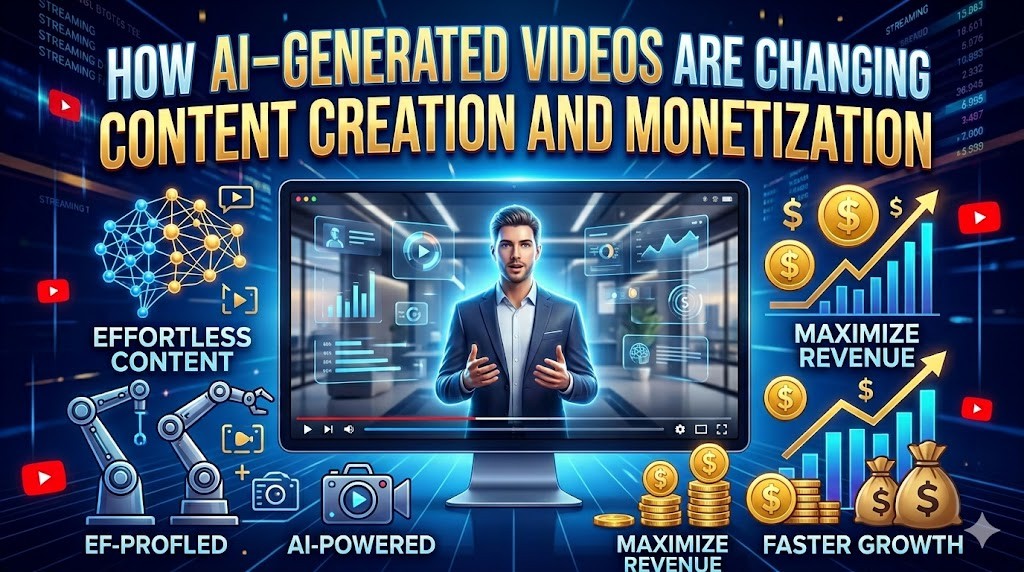

Artificial intelligence has fundamentally reshaped the digital landscape, but nowhere is this transformation more visible than in video production. The emergence of AI-generated video tools has democratized a process that was once reserved for large studios with massive budgets. This shift is not merely about saving time; it is about redefining the very nature of storytelling, marketing, and audience engagement.
As we move further into a digital-first economy, content creators are facing increasing pressure to produce high-quality video content consistently. Traditional methods involve scripting, filming, editing, and rendering, a process that can take weeks for a single minute of polished footage. AI tools compress this timeline dramatically, allowing creators to focus on strategy and creativity rather than technical execution.
The implications for monetization are equally profound. With production costs dropping and output increasing, creators can scale their revenue streams through ad placements, sponsorships, and subscription models more effectively than ever before.
📊 Overview of the AI Video Revolution
The rise of AI-generated videos represents a paradigm shift in how digital media is consumed and produced. This technology leverages advanced machine learning algorithms to synthesize visual and auditory elements without the need for physical cameras or actors. The result is a scalable, efficient, and increasingly realistic method of content generation.
This technology is currently driving significant changes in the advertising industry, educational platforms, and entertainment sectors. Businesses are adopting these tools to create personalized video ads for different customer segments without hiring separate production crews for each variation. This level of personalization was previously impossible at scale.
For the independent creator, these tools offer a lifeline. They allow a single individual to produce content that rivals the output of a small agency. This democratization of video production is unlocking new economic opportunities for creators in developing regions where traditional production infrastructure may be lacking.
Understanding this shift requires recognizing that AI is not replacing human creativity but augmenting it. The technology handles the heavy lifting of rendering and editing, freeing the human mind to focus on narrative structure and emotional resonance.
🔍 Market Analysis and Technical Context
The market for AI video generation is expanding at an unprecedented rate. Industry analysts predict significant growth in the coming years as the technology matures and becomes more accessible to non-technical users.
1) Technical background: The core technology relies on Generative Adversarial Networks and transformer models that understand natural language and convert text prompts into coherent visual sequences.
2) Why users search for this topic: Users are actively seeking ways to reduce production costs and increase output velocity. The demand is driven by the saturation of video content across social media platforms.
3) Market or industry relevance: The video marketing industry is valued in the hundreds of billions, and AI tools are capturing a significant share of this market by offering cost-effective alternatives.
4) Future outlook: As computing power increases, the fidelity of AI video will improve, potentially leading to photorealistic avatars and fully synthetic cinematic environments.
💡 Important note: Understanding the underlying technology helps users choose the right tool for their specific needs rather than chasing the latest hype.
⚙️ Understanding the Technology
🤖 What is AI Video Generation?
AI video generation refers to the automated creation of video content using artificial intelligence algorithms. These systems can produce entire videos from text prompts, generate avatars that speak scripted dialogue, or edit existing footage based on natural language instructions.
This technology operates by analyzing vast datasets of video and audio to learn patterns of human movement, speech, and visual composition. It then synthesizes new content that adheres to these learned patterns while adhering to the specific constraints provided by the user.
- Core definition: Automated video synthesis using machine learning models.
- Primary function: Transforming text or static images into dynamic video clips.
- Target users: Marketers, educators, content creators, and enterprise communication teams.
- Technical category: Generative AI and Computer Vision.
🔧 How Does the Technology Work?
The process begins with a text prompt or a script input. The system parses this input to understand the semantic meaning and intent behind the words. It then maps these concepts to visual tokens that represent the desired imagery.
Behind the scenes, a diffusion model iteratively refines random noise into a coherent image or video frame. For avatars, the system utilizes voice synthesis to match the lip movements of the generated character with the audio track. This synchronization is achieved through advanced facial landmark detection and animation.
Rendering is handled on cloud servers to manage the heavy computational load. This allows users to access powerful video processing capabilities without needing high-end local hardware. The output is then encoded into standard video formats for easy distribution across platforms.
Continuous feedback loops allow the models to improve over time. As more data is processed, the system learns to avoid artifacts and generate smoother transitions between scenes.
🚀 Key Features and Capabilities
✨ Core Functionalities
Modern AI video platforms offer a suite of features designed to streamline the production workflow. These tools are built to handle the entire lifecycle of video creation from script to final export.
Users can leverage text-to-video capabilities to generate B-roll footage instantly. This eliminates the need to stockpile stock footage or hire videographers for simple illustrative clips.
Avatar creation is another staple feature. Users can choose from a library of diverse digital humans or upload a photo to create a custom representative. These avatars can speak with realistic voiceovers that support multiple languages.
- Text-to-Video: Converts written scripts directly into visual scenes.
- Avatar Synthesis: Creates digital presenters for training or marketing.
- Auto-Editing: Automatically cuts and arranges clips based on pacing.
- Voice Cloning: Replicates specific voice tones for consistent branding.
📊 Performance Metrics and Comparison
To understand the value proposition of these tools, it is essential to compare them against traditional production methods.
| Feature | AI Generation | Traditional Production |
|---|---|---|
| Time per Minute | Minutes to Hours | Days to Weeks |
| Cost | Subscription Based | Huge Upfront Cost |
| Scalability | High | Low |
| Customization | Medium | High |
The table above highlights the efficiency gains offered by AI tools. While traditional production allows for higher customization, the time and cost savings of AI generation make it the superior choice for high-volume content needs.
For businesses, the return on investment is clear. A marketing campaign that previously required a budget of ten thousand dollars can now be executed for a fraction of that cost using AI avatars and automated editing.
🆚 Competitive Landscape
The market is populated by several key players, each offering unique strengths. Synthesia is known for its enterprise-grade avatars and security features. Pictory focuses on converting blog posts into videos. HeyGen offers high-fidelity lip-syncing capabilities.
1) Synthesia excels in corporate training scenarios where consistency and professionalism are paramount.
2) Pictory is ideal for content marketers who want to repurpose written articles into video format quickly.
3) HeyGen is preferred by creators who prioritize realistic avatars and multi-language support.
📈 Advantages and Disadvantages
✅ Strengths
The primary advantage of AI video generation is efficiency. It removes the bottlenecks associated with scheduling, filming, and post-production. This allows creators to iterate on ideas rapidly without incurring significant costs.
Another benefit is accessibility. Creators who are not comfortable on camera can still produce video content. This removes a psychological barrier that prevents many potential creators from entering the video space.
- Speed: Drastic reduction in production time.
- Cost: Lower operational expenses.
- Accessibility: No need for physical cameras or actors.
- Consistency: Uniform brand voice and visual style.
❌ Limitations
Despite the benefits, there are significant limitations. The emotional nuance of human acting is difficult to replicate fully. AI avatars can sometimes exhibit uncanny valley effects that distract viewers.
Additionally, the technology is not yet perfect at handling complex physical interactions. If a scene requires two people interacting naturally, current AI tools may struggle to render the physics accurately.
- Lack of Emotion: Hard to convey deep human feelings.
- Complexity: Struggles with intricate physical scenes.
- Copyright: Legal gray areas regarding AI-generated ownership.
- Overuse: Risk of content saturation and viewer fatigue.
💻 Technical Requirements
While the processing happens in the cloud, users still need a reliable environment to access these tools effectively.
🖥️ Minimum Specifications
A standard modern computer with a web browser is sufficient for accessing most platforms. Internet connectivity is the most critical factor, as the rendering occurs remotely.
⚡ Recommended Specifications
For users who intend to do local editing alongside AI generation, a dedicated GPU is recommended. This ensures smooth playback of high-resolution assets and faster export times for final renders.
| Component | Minimum | Recommended |
|---|---|---|
| Processor | Quad-Core | Octa-Core |
| RAM | 8 GB | 16 GB |
| Storage | 50 GB SSD | 500 GB NVMe |
The recommended specifications ensure a smooth workflow when managing multiple projects simultaneously. Users with lower specs may experience lag during the editing phase before export.
🛠️ Practical Implementation Guide
🧩 Setting Up Your Workflow
Successful AI video creation requires a structured approach. First, define your script clearly. AI tools perform best when the narrative is well-defined and concise.
Next, select the appropriate avatar or visual style. Consistency is key for branding. Once the assets are selected, import your voiceover or use the text-to-speech engine. Finally, review the generated video and make necessary adjustments.
- Scripting: Write a clear, concise script for the video.
- Asset Selection: Choose avatars and backgrounds that match your brand.
- Generation: Input the script and generate the initial video.
- Review: Check for errors in lip-sync or visual glitches.
- Export: Download the final file in the required format.
🛡️ Troubleshooting Common Issues
Users often encounter specific challenges when working with these tools. Understanding common errors can save significant time.
- Audio Sync Issues: Ensure the script length matches the reading speed of the avatar.
- Visual Glitches: Check the resolution settings and regenerate problematic clips.
- Brand Mismatch: Use custom color palettes to align with existing brand guidelines.
💡 Tactical Tip: Always export a test version before committing to a full production run to catch errors early.
📈 Performance and User Reception
🎮 Real-World Performance
Platforms like Synthesia and Pictory have demonstrated strong uptime and rendering speeds. Most users report generation times of under ten minutes for standard length videos.
Resource usage is minimal on the client side, as the heavy lifting is done on the server. This makes the tools accessible on low-end laptops and tablets.
🌍 Global User Ratings
1) Average rating: Most platforms maintain ratings above four stars on review sites.
2) Positive feedback reasons: Users praise the speed and ease of use.
3) Negative feedback reasons: Complaints often focus on the lack of human nuance in avatars.
4) Trend analysis: Satisfaction is increasing as the technology improves annually.
🔐 Security and Ethics
🔒 Security Level
Enterprise-grade tools implement strict security protocols to protect user data. Video assets are stored on encrypted servers, and access is controlled via authentication.
However, users must be cautious about the data they input. Sensitive information should not be processed through public generation tools.
🛑 Potential Risks
The primary risk is the misuse of the technology for misinformation. Deepfakes can be created to spread false narratives.
- Deepfakes: Risk of creating fake identities for malicious purposes.
- Copyright: Legal uncertainty regarding ownership of AI-generated content.
- Trust: Viewers may lose trust in video content overall.
🆚 Alternatives and Comparison
🥇 Best Available Options
While AI video is dominant, traditional methods still have their place. Human actors can convey emotion that AI cannot replicate.
1) Enterprise AI: Best for training and internal comms.
2) Traditional Production: Best for cinematic storytelling.
3) Hybrid Approach: Combining AI assets with human filming.
The choice depends on the goal of the project. For mass communication, AI wins. For emotional connection, humans win.
💡 Optimization Tips
🎯 Best Settings for Performance
To maximize output quality, users should utilize high-resolution templates. Lower resolution settings may save credits but result in pixelated video.
- Resolution: Always select 1080p or higher.
- Format: Use MP4 for maximum compatibility.
- Audio: Use high-quality voiceover models.
📌 Advanced Tricks
Experienced users know how to manipulate scripts to control pacing. Breaking long sentences into shorter phrases forces the avatar to pause naturally, adding emphasis.
Additionally, mixing AI avatars with stock footage can enhance the visual interest of the video without increasing production time.
🏁 Final Verdict
AI-generated video is not a fleeting trend; it is a fundamental shift in media production. The ability to scale content creation while reducing costs makes it an essential tool for modern businesses.
While it cannot fully replace human creativity, it serves as a powerful amplifier. Creators who adopt these tools now will have a significant competitive advantage in the coming years.
❓ Frequently Asked Questions
1) Is AI video legal to use for monetization? Yes, provided you own the rights to the generated content according to the platform’s terms of service.
2) Can I use my own voice with these tools? Many platforms offer voice cloning features that allow you to replicate your specific voice for consistency.
3) How much does AI video software cost? Pricing varies from free tiers to enterprise subscriptions, typically ranging from twenty to three hundred dollars per month.
4) Can AI generate videos in different languages? Yes, most tools support multi-language output with appropriate voice synthesis.
5) What is the best software for beginners? Tools with drag-and-drop interfaces are best for those new to video production.
6) Does AI video look like real humans? It is improving rapidly, but subtle uncanny valley effects may still be visible upon close inspection.
7) Can I edit AI videos after generation? Yes, most platforms allow for basic editing of text and scene order before export.
8) Are there risks to my brand reputation? Overuse of generic avatars can make a brand seem impersonal, so usage should be strategic.
9) How long does it take to render a video? Render times typically range from five to thirty minutes depending on length and complexity.
10) Can I use AI video for YouTube? Yes, YouTube allows AI-generated content as long as it complies with community guidelines regarding authenticity.